
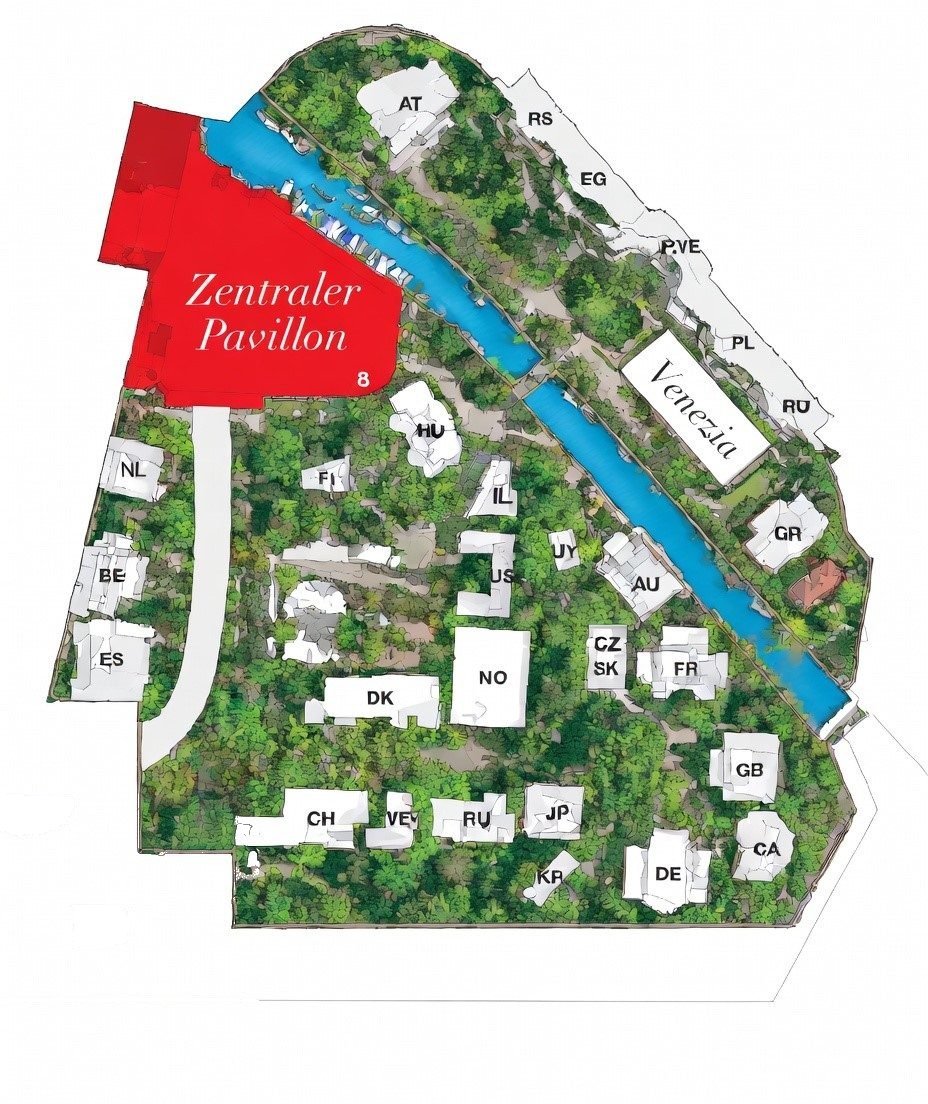
The national pavilions in detail
Central Pavilion
The exhibition begins even before you enter: Nigerian-Belgian artist Otobong Nkanga has wrapped the four white Modernist columns in front of the Central Pavilion in Venetian brick, hanging glass terrariums, clay flower pots, and wooden bee hotels from them. The plants will overgrow the columns over the months — an image of what the entire show is about: quiet transformation rather than spectacle.
Curator Koyo Kouoh — the first African woman in this role — died unexpectedly in May 2025, after having fully developed the concept. Her team is realising her vision: "In Minor Keys" invites visitors to "listen in minor keys" — to the whispered, the peripheral, the islands of dignity. Not an escape from the crises of our time, but a radical return to the emotional, the sensory, the subjective.
The exhibition is organised around four interweaving moods — not as themed rooms but as atmospheres flowing into one another. "Shrines" at the heart of the pavilion is dedicated to the Senegalese poet Issa Samb and the American sculptor Beverly Buchanan — both shaped Kouoh's thinking. "Procession" is embodied by Big Chief Demond Melancon's Amistad Takeover: an orange glass-beaded suit with the slave uprising on the ship Amistad (1839) stitched into it, every bead sewn by hand. "Rest" offers spaces of pause by Kader Attia, Wangechi Mutu, and Helen Sebidi, the oldest participant at 83. "Schools" gives space to six artist-led institutions, including RAW Material Company in Dakar, founded by Kouoh herself.
Don't miss: Maria Magdalena Campos-Pons has portrayed Koyo Kouoh herself in a wall-filling watercolour composition — side by side with Nobel laureate Toni Morrison, wrapped in magnolia branches — accompanied by seven glass and ceramic magnolias on plinths in front. Indigo banners with poems (including by Palestinian poet Refaat al-Areer) thread through the rooms like a blue ribbon. The scenography by South African Wolff Architects plays with thresholds and filtered light — inspired by the Japanese word "komorebi", the dappled light passing through leaves.
Altogether 110 artists, duos, and collectives from around the world are gathered, with a strong emphasis on voices from the Global South. Tip: don't move through the pavilion like a checklist. Sit down, listen, look twice. Much speaks of mourning, but everything is also a form of solace.
Switzerland
What holds societies together – and what drives them apart? In the Swiss Pavilion, the Swiss collective asks precisely this question – and does so with astonishing clarity. The starting point is a corpus of documents from the long-running Swiss talk show "Club", which has staged public debate on Swiss television since 1958.
The six-member collective – Gianmaria Andreetta (Lugano/Berlin), Luca Beeler (Zurich), British artist Nina Wakeford (London), Miriam Laura Leonardi (Zurich), Lithic Alliance (Zurich/Brussels) and Yul Tomatala – has selected and translated material from this archive into a multimedia installation.
Through montage and re-staging of these talk-show mechanisms, an installation emerges that dissects media structures: How does tolerance arise under pressure? Where does division begin?
Russia
The only pavilion in the Giardini with a view of the lagoon – and the only one no one is allowed to enter. Russia's return to Venice happens behind closed doors: what unfolded inside, visitors only see as a recording, on screens behind the windows.
After two editions of absence – in 2022 curators and artists withdrew in protest against the war, in 2024 Moscow handed its pavilion over to Bolivia – Russia is back in 2026. The format is unprecedented: from 5 to 8 May the pavilion was accessible exclusively to press and accredited professionals, to document a three-day music and performance festival. With the public opening of the Biennale on 9 May it closed, and stays closed until the show ends on 22 November. What remains is the filmed memory of three days in a building that locks itself out immediately afterwards.
"The Tree is Rooted in the Sky" understands itself as a polyphonic dialogue of cultures. Around 40 young musicians, poets and philosophers – mostly from Russia, joined by voices from Mali, Brazil, Mexico and Argentina – weave folk, improvisation and electronic sets all the way to techno. The interior is staged like a flower shop, pervaded by scents and sensory atmospheres. The title refers to the French philosopher Simone Weil and her notion that creativity originates not from the mundane but from the divine – the cosmic tree as an axis between earth and sky.
The return is highly contested. Twenty-two European ministries of culture and foreign affairs have formally protested, Italy's Minister of Culture Alessandro Giuli is boycotting the opening, and 37 members of the European Parliament are calling for the suspension of the Biennale's two-million-euro EU funding. Commissioner Karneeva was sanctioned by Kyiv in April 2026 – her father Nikolai Volobuyev is a former FSB general and was deputy general director of the Russian defence conglomerate Rostec. The ensemble includes members of the folk collective Toloka, which publicly supports Russian soldiers in the war in Ukraine. On 6 May, Pussy Riot and FEMEN demonstrated in front of the pavilion. The five-member Biennale jury also ruled that Russia and Israel are excluded from receiving the Golden Lions: the leaderships of both states face charges before the International Criminal Court.
Japan
Building on his experience as a queer parent, Ei Arakawa-Nash presents an installation shaped by themes of identity and parenthood. Visitors are invited to carry a baby doll through the space and become part of the work themselves.
The starting point of the installation is Natto Wada's 1962 film "Being Two Isn't Easy", which tells the first two years of a child's life from its own perspective and from those of the parents – a mother, a father, a child. From this, Arakawa-Nash develops a contemporary, queer-coded reading of family.
The title brings two symbols into dialogue – grass, associated with garden and nature, and moon, linked to time and emotion – and reflects on relationships, care and affection. With over a hundred doll bodies, the pavilion becomes a site of communal carrying, vulnerability and tenderness.
South Korea
Red copper pipes pierce the walls, columns and stairways of the Korean Pavilion like acupuncture needles piercing a body – and, for the first time in the history of the Biennale, reach across the hedge into the neighbouring Japan Pavilion. This visible gesture – the fortress becomes permeable, former colonial power and once-colonised nation open a shared space – is the heart of what curator Binna Choi calls "Liberation Space".
The title refers to a concrete historical period: the three years between Korea's liberation from Japanese colonialism in 1945 and the establishment of separate governments on the peninsula in 1948 – a brief, open transitional phase, often remembered as chaotic and unfinished. Choi rereads it: not as a failed moment, but as an ongoing movement that continues to be shaped in the present. The trigger is the recent declaration of martial law by President Yoon Suk Yeol in December 2024 – blocked within hours by citizens and parliament, followed by four months of impeachment protests and ultimately Yoon's removal from office.
Two sculptural works carry the pavilion. Goen Choi's "Meridian" (in collaboration with Thirdhand): cut and bent industrial copper pipes running through the architecture like exposed veins – an image for the invisible infrastructure through which circulation and breath return to a blocked body. Hyeree Ro's "Bearing" forms its counterpart: around 4,000 pieces of wax-coated organza stretched into a wafer-thin, skin-like membrane that encompasses eight thematic stations – outlooking, mourning, living, planning, waiting, mending, remembering, sharing. Fortress and nest – hardness and care – relate to one another rather than excluding each other.
One of the stations is dedicated to Nobel laureate Han Kang: her installation "The Funeral" (2018) commemorates the victims of the Jeju 4.3 Uprising (1947–1954) – deliberately placed low to the ground so that viewers must bow before it. "Liberation is not a finished condition," says Binna Choi, "but something we have to negotiate again and again." Instead of a classical national pavilion, what emerges is a walkable monument: fragile, permeable, carried by solidarity and collective imagination.
Germany
Sung Tieu has clad the German Pavilion's Nazi-era façade in more than three million marble mosaic tesserae – a 1:1 reproduction of a GDR prefab housing block on Berlin's Gehrenseestrasse, once a dormitory for Vietnamese contract workers, now slated for demolition. The work is titled "Human Dignity Shall Be Inviolable" – Article 1 of Germany's Basic Law, laid over Ernst Haiger's monumental architecture of 1938. Two German representational buildings that should exclude one another hold each other up in the same wall.
Henrike Naumann did not live to see the opening. On 14 February 2026 she died aged 41 from a cancer diagnosed far too late, just months after her nomination. Until the very end she worked on "The Home Front", now realised posthumously by her studio and the pavilion team: green walls echoing abandoned Soviet barracks in East Germany, on one side a reworked Socialist Realist mural by her grandfather from Karl-Marx-Stadt, opposite a three-dimensional living room in the idiom of Neues Deutsches Design – rendered only in greys and blacks, the bed as austere as a prison cell.
"Ruin" – in English the architectural remnant, in German the state itself: financial, social, moral collapse. Naumann, who grew up in Zwickau where the right-wing terror group NSU would later kill, spent her career asking how ideologies live on in furniture, wallpaper and children's bedrooms long after the regimes themselves have fallen. "However homely you try to make yourself in the German Pavilion," says curator Kathleen Reinhardt, "it remains a hostile place."
Canada
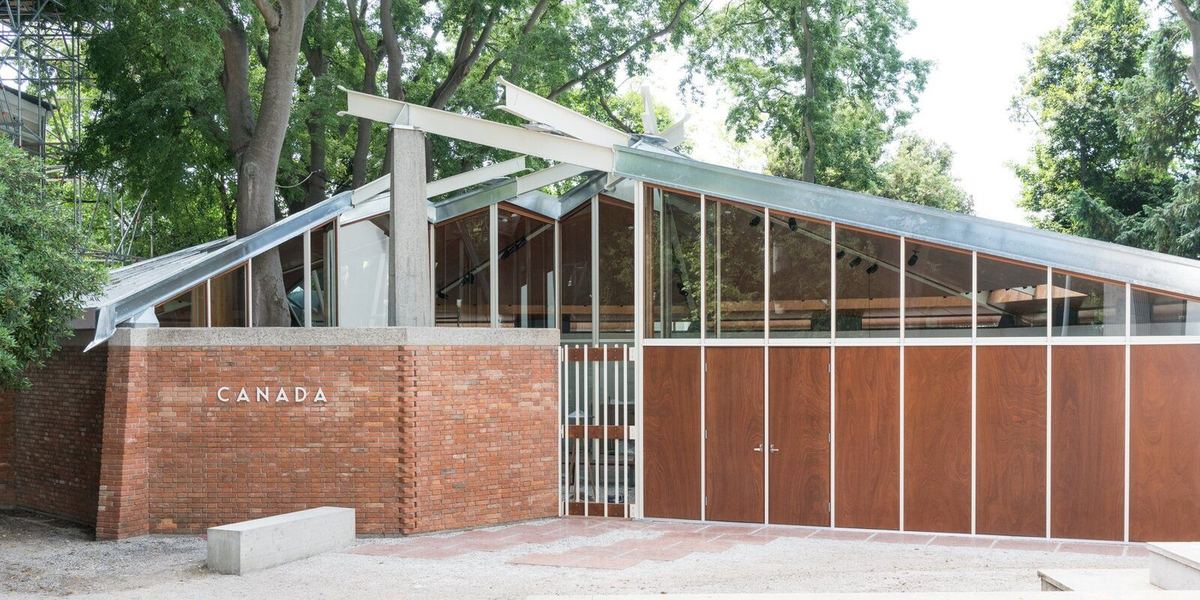
On one half of the Canadian Pavilion lies a pond – around 23,000 litres of water, roughly 25 tons in weight, heated, humidified, under grow lights. Three giant water lilies of the genus Victoria drift across it; by summer their leaves are expected to reach up to one and a half metres in diameter. Once a night a pure-white flower opens and lures a beetle. The plants are 100 million years old; their name is barely 150.
Abbas Akhavan turns precisely this gap into his subject. Native to South America, the Victoria water lily reached Europe in the 19th century via the botanical networks of the British Empire and was dedicated to Queen Victoria – a triumph of Victorian natural history, prominently staged at the Crystal Palace for the 1851 Great Exhibition. In the same century Canada was founded, in 1867, as a Dominion of the same crown. The seeds of the plants now floating in Venice come from the Royal Botanic Gardens, Kew in London (whose Waterlily House is currently under renovation), were germinated at the Orto Botanico di Padova and travelled from there to the pavilion. Akhavan turns the building into a monumental Wardian case – the 19th-century glass container in which plants were shipped across the Empire.
"Entre chien et loup", the French hour of dusk, runs through the entire installation. What looks like birch sticks forgotten on the floor is bronze. What looks like incidental rocks at the entrance is Italian volcanic stone, deliberately placed. An old fur coat thrown over a stone serves as a fountain, water trickling out of one sleeve. Akhavan, born in Tehran, lives between Montreal and Berlin; he asks about the geopolitical forces that shape spaces and plants, nations and names – and suggests that in this hour of half-light it is worth looking more closely.
Great Britain
Lubaina Himid, a pioneer of the Black British Art Movement, has for decades brought Black history and culture into contemporary art space, weaving race, feminism and colonial memory into a single fabric. Emeritus Professor of Contemporary Art at the University of Central Lancashire and the first Black woman to win the Turner Prize, in 2017, she works at the intersection of historical research and literary narrative – a language that makes long-marginalised identities visible.
In the first room, two architects design two possible houses: one on wheels, ready for flight, the other a fixed shelter for those who choose to stay. This is how Himid opens the British Pavilion. Five large multi-panel paintings – Architects, Tailors, Chefs – hang alone on otherwise bare walls. Alongside them: 21 mismatched oars in a row and a wall of 26 questions for today. Over it all, a soundscape by Magda Stawarska drifts through the building like a long summer afternoon.
"Predicting History: Testing Translation" – history resists prediction, translation remains approximation. Himid, born in Zanzibar in 1954 and brought to England as a baby, treats the neo-classical British Pavilion as a stand-in for Britain itself: welcoming, airy, full of possibility – and, in its sounds and texts, subtly uneasy. "Although I've lived here for 71 years," she says, "I always know: I'm in the right place and at the same time in the wrong one."
France
"Comme Saturne" – like Saturn, the Revolution devours its children. With this phrase, coined by the Girondin Pierre Victurnien Vergniaud shortly before his execution in 1793, Yto Barrada opens the newly renovated French Pavilion. She translates it into textile: draped wool, mechanical contraptions, fabrics that daylight bleaches and alters over the six months of the show – matter and time as counterparts.
Saturn is doubly present here: as patron of those artists believed to be born under his sign – melancholy, withdrawal, slow thought – and as the revolutionary father figure who devours his sons. Barrada translates this double gaze between creation and destruction with the technique dévoré, a chemical process that dissolves the surface of a fabric so that form emerges out of absence. A "wheel of rules and constraints" bows to the Paris writers' collective OuLiPo – repetition, permutation and play as a generative principle. The Salle des plis (Room of Folds) turns the wool itself into architecture.
Yto Barrada, born in Paris in 1971 to Moroccan parents, lives between Tangier and New York. In Tangier she runs The Mothership, a pan-African, eco-feminist research centre with a dye garden and residencies – Venice becomes its next node. Folded into the saturnian orbit: an archaeological find from the Château de Gambais, the filming location of Jacques Demy's fairy-tale musical "Peau d'âne" (1970). The exhibition, Barrada says, is "less an escape than a tool for poetic survival".
Australia
Images flowing over images. In Khaled Sabsabi's Australian Pavilion, ceiling-mounted projectors cast moving sequences in a 54-minute loop onto eight large paintings – three metres by two, arranged as an octagon. Over it all, a soundscape of everyday noises recorded on analogue tape. Whoever steps into the centre stands at the heart of a slow conversation with oneself.
The title points to the twelve-centuries-old Sufi allegory "The Conference of the Birds" by the Persian poet Farid al-Din ʿAṭṭār: a pilgrimage through seven valleys – Quest, Love, Knowledge, Detachment, Unity, Wonder, Annihilation of the Self – at the end of which lies the insight that the divine dwells in the seeker. Sabsabi adds an eighth valley: Wholeness. In the Arsenale, in the main exhibition "In Minor Keys", the companion piece "khalil" (Arabic for "friend") unfolds – a floating, lamp-like installation made of 40 metres of painted canvas. While the pavilion shows the outward dimension of the self, "khalil" turns inward. Both are rooted in tasawwuf, the mystical tradition of Sufism. Sabsabi is the first Australian artist to appear simultaneously in the national pavilion and in the main exhibition.
Sabsabi, born in Tripoli in 1965 and arrived as a child in Western Sydney in 1976, having fled the Lebanese civil war, has for more than 35 years worked out of hip-hop and youth culture with Arab, Indigenous and Pacific communities, in schools, prisons, refugee and youth centres. In February 2025 his pavilion commission was withdrawn by Creative Australia – days after the appointment – after a conservative senator raised questions in parliament about his early works. Resignations, protests, boycotts and an official inquiry followed. Six months later, Sabsabi and Dagostino were reinstated. His work in Venice – slow, contemplative, inviting – is the answer.
Uruguay
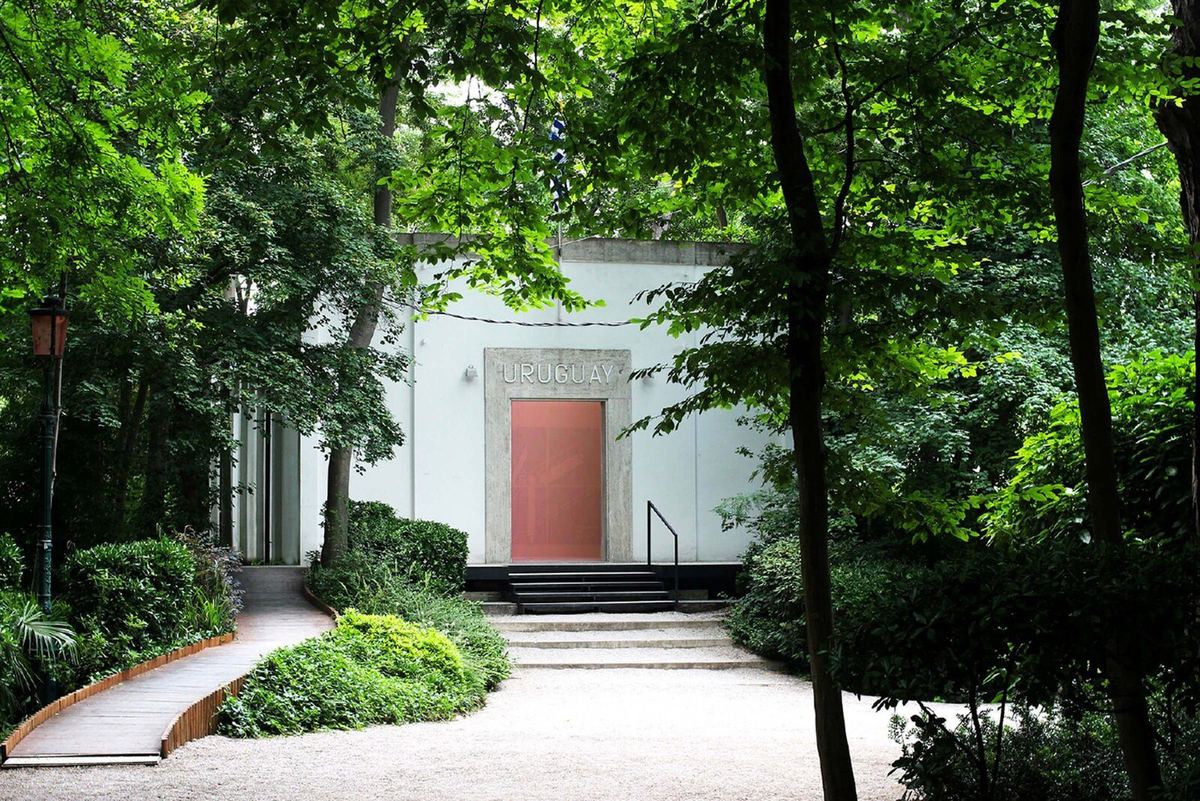
With "ANTIFRAGILE", Margaret Whyte – born in Montevideo in 1940 and active for over five decades in painting, assemblage and performance – takes up a concept of statistician Nassim Nicholas Taleb: not robust against shocks, but stronger because of them. The pavilion becomes a chamber where damage and survival are intertwined.
The installation combines textiles with obsolete technical objects – decommissioned machines, motorcycle helmets, debris. "The materials I work with carry stories of use, fall and reuse," says Whyte. The smallest pavilion in the Giardini becomes a chamber in which fragility flips into resilience.
For curator Patricia Bentancur, the individual positions are "political technologies of protest and belonging": the weaving together of fragments becomes a model of thought that holds plural narratives.
Nordic Countries (Finland, Norway & Sweden)
A twelve-metre fallen "female tree" lies in the Nordic Pavilion, branches stretched toward the sky, its bark sewn from coloured old rag rugs. Above and beneath it: eleven sculptures in bronze, ceramic and wood – "like different voices in a choir", says Klara Kristalova of her work "Lust for Life", the title borrowed from Iggy Pop. On the other side of the room Tori Wrånes lets a foghorn sound every hour – signal from sea navigation, warning at once. Between them Benjamin Orlow's monumental sculptures on cycles of transformation. Sverre Fehn's light-flooded 1962 building becomes a mythical stage.
"How Many Angels Can Dance on the Head of a Pin?" – the medieval scholastic question stands for the speculative, the suspended, the unprovable, and at once for the question of how many beings can inhabit the same space. Curator Anna Mustonen leads the three artists into a shared mythical landscape in which plant, animal and human dissolve into one another. The references reach from the Kalevala – the 19th-century Finnish-Karelian creation epic – to global narratives of coexistence and ecological vulnerability. Kristalova's reclining tree, she says, has "fallen. I was also thinking about the ecological collapse that is approaching fast."
Three voices from the Czech Republic (resident in Sweden), Finland (resident in London) and Norway play Fehn's timeless building together, commissioned by Kiasma, Moderna Museet and OCA. Directly opposite, in the Giardini, stands the Russian Pavilion – a neighbour hard to ignore at this Biennale: on opening day a large demonstration took place in front of its door. A symmetry that Kristalova described as "affecting us very much".
Denmark
With "Things to Come", Maja Malou Lyse – born in Copenhagen in 1993 and thus the youngest artist ever to take over the Danish Pavilion – develops an immersive film environment in which science fiction, feminism and reproductive history collide.
At the centre is a speculative video fairy tale set in 2045: adult performer Nicolette Shea plays a scientist in a futuristic sperm bank. Drawing on motifs from Margaret Atwood, biomedical research and pop culture, Lyse develops a scenario in which control over reproduction has become a battlefield.
Lyse is regarded as one of the formative voices of the fourth feminist wave in Denmark. Her practice spans installation, performance, video and text and revolves around objectification, identity and social norms.
Qatar
With "untitled 2026 (a gathering of remarkable people)", Qatar in 2026 presents its own national pavilion at the Giardini for the first time. Since the permanent pavilion by Lina Ghotmeh is still under construction, the contribution this year takes place in a temporary tent structure designed by Tiravanija himself.
Tiravanija invites four contributors from the Arab world to activate the space. Qatari-American artist Sophia Al-Maria shows an experimental narrative film whose protagonist navigates futuristic Gulf landscapes. Lebanese sound artist Tarek Atoui develops a sound-architectural intervention. Kuwaiti-Puerto Rican artist Alia Farid contributes textile sculptures and a video work.
The fourth pole is a culinary programme by Palestinian chef and author Fadi Kattan: chefs from the MENA region reinterpret the traditional dish harees/jareesh in ever new variations. Tiravanija turns the pavilion into a place of dwelling and shared eating.
Spain
Anyone who enters the Spanish Pavilion expects art. They find postcards. Thousands of them — and together they produce something one does not soon forget.
Oriol Vilanova, Catalan artist and self-confessed flâneur of Brussels flea markets, has dedicated his life to collecting. Postcards from the late 19th century to today cover all the walls — not as decoration, but as archive. From iconic monuments to everyday motifs, from kitsch to history, from forgotten places to repeated views.
"Postcards are copies of copies, mass goods without claim — and precisely for that reason the most honest mirror of our visual world."
In a time when we are flooded daily with digital images, Vilanova makes the analogue visible: as archive, as obsession, as quiet critique of capitalism. The title is the programme: what remains of an image after its reproduction? What of an experience after its souvenir?
Curated by Carles Guerra, the pavilion fits perfectly with the Biennale theme "In Minor Keys" — a tribute to the marginal, the overlooked, the quiet. No volume, no spectacle. Just the silent backs of the postcards, on which someone once wrote: "I am here. I am thinking of you."
Israel
Important note: The historic Giardini Pavilion of Israel is being renovated in 2026. The exhibition takes place instead at the Arsenale, in the Armoury G of the Sale d'Armi – unusual for Israel, which has always exhibited in the Giardini.
Israel is represented by Belu-Simion Fainaru, born in Bucharest in 1959 and living in Haifa since the early 1970s. Awarded the Israel Prize in 2025, he is one of the formative sculptors of contemporary Israeli art.
With "Rose of Nothingness", Fainaru shows an immersive water installation, originally conceived in 2015: 16 pipes hanging from the ceiling drip black water into a shallow basin – a continuous, meditative event. The work refers to Paul Celan's "Psalm" and to the question of what speaking remains possible after catastrophe.
Israel's participation in 2026 takes place under particular political signs: the five-member Biennale jury decided in April 2026 that countries whose government leadership is charged by the International Criminal Court will receive separate display areas. Israel exhibits, but with curatorial framing.
United States
With "Call Me the Breeze", Alma Allen shows around 30 sculptures, including several new, site-specific works – one of them in the forecourt of the pavilion. The Utah-born artist, who has lived in Tepoztlán (Mexico) for years, works with marble, bronze, wood and stone, weaving Surrealist, Indigenous and modernist references into objects of monumental serenity.
The title "Call Me the Breeze" refers to the concept of "Elevation": elevation as physical form, as emotional state and as a shared hope for the future. Curated by Jeffrey Uslip, commissioned by Jenni Parido of the American Arts Conservancy in cooperation with the U.S. Department of State.
The selection process in 2026 was unusual: the National Endowment for the Arts was not involved this time, the 43-day Government Shutdown delayed the announcement; new requirements from the Trump administration shaped the selection. Allen, however, is regarded as a depoliticized choice that brings together craft, materiality and contemplative form.
Belgium
Numbered towels hang on the walls of the Belgian Pavilion; performers in black jerseys wait at the drums. A wooden tribune climbs up into the hall, its tiers lined with plaster tablets bearing imprinted words in different languages: "hello", "salam", "stop", "ha", "dai" – and everywhere "SSST", the silent "shhh" that calls for quiet. Several times a day nine performers activate the room: words are passed along, dragged, sung, smashed. Beside them, workers continuously pour plaster into silicone moulds – material that will be broken apart in the next performances.
"It's flooded, the way a head is flooded now with all the questions and barricades in life," says Miet Warlop of "IT NEVER SSST". The title plays at once with "it never s-s-stops" and with the Belgian "ssst" for "Quiet!". But the silencing is meant to break: over the course of the Biennale the plaster "SSST" tablets are gradually replaced by words and sounds in the performers' own mother tongues. Plaster becomes a material for a game of repetition and decay – fluid, hardenable, brittle, cast again and again. The music is composed by Warlop together with Micha Volders, Oscar Claus and Rahmat Emonds.
Netherlands
With "The Fortress", the Netherlands in 2026 for the first time shows a performance in its own pavilion – and the building itself becomes part of the work. Dries Verhoeven and curator Rieke Vos transform Rietveld's light, transparent building into its own antithesis: at fixed intervals throughout the day, steel shutters rattle down in front of the glass facades. From a sun-flooded symbol of openness, progress and post-war optimism the building turns into a dark, fortress-like shell.
Inside, thirteen international performers respond to the incursion of darkness with a raw, vocal performance – gradually distancing themselves from the audience, "as if the darkness itself were taking possession". Despair, abandonment, the creeping end of an enlightened age: the work asks how Western societies respond to geopolitical insecurity – with walls, rearmament, closed borders – and shows how shelters can become prisons.
Verhoeven and Vos understand the contribution explicitly as a comment on the Biennale itself: the arrangement of the thirty national pavilions reflects a past world order in which former great powers – mostly Western – stand side by side "in apparent unity", even as many countries close their borders, rearm or wage wars. "The Fortress" is the answer to this paradox.
Finland
For the 70th anniversary of the Finnish Pavilion, Jenna Sutela transforms Aalto's luminous building with "Aeolian Suite" into a "Windscape" – a multisensory landscape of sound and movement that makes meteorological data tangible.
At the centre are the five Venetian winds – Tramontana, two different Boras, Scirocco and Garbin – as personified protagonists who "sing" the weather and at the same time provide instructions for living with it. Glass sculptures, sound compositions and air movements meet in the space.
"Aeolian Suite" connects scientific and poetic forms of knowledge: in collaboration with scientists from the Institute of Marine Sciences CNR-ISMAR, Sutela investigates forecasting methods such as "Wisdom of Crowds" – the art of making prognoses through collective expertise.
The title is also a direct nod to Koyo Kouoh's leitmotif "In Minor Keys": "Aeolian" refers to the Aeolian mode – the natural minor scale of Western music theory. Sutela, originally trained as a media artist, here brings together music, science and architecture.
Hungary
Massive ventilation elements from the 200-year-old listed building of the Hungarian Academy of Sciences stand in the Hungarian Pavilion: dismantled metal pipes, filters and flaps that once regulated the breath above the heads of academicians. Endre Koronczi calls this first installation "Trapped Breath" and credits the devices with having absorbed "the breath, sighs and oxygen passing through the brains of the greats of Hungarian scientific life". It is, as commissioner Júlia Fabényi puts it, a "museum of breath".
A second installation documents on video Koronczi's year-long walk in search of "the most important sigh". A third turns one of the pavilion's walls into a "breathing wall". Over all of it lies the sound layer of Hungarian composer Máté Balogh, who shapes tones out of the ventilation parts – the devices become resonance chambers of their own former task. Scientific logic and artistic intuition flow into one another; the result is conjecture rather than proof: the Ancient Greek pneuma – breath, spirit, life force – as an all-pervading, invisible current.
Endre Koronczi (b. 1968 Budapest), since the 1990s a defining figure of Hungarian conceptual art, has for nearly 20 years devoted himself exclusively to wind-based work – installations, videos, photographs, open-air projects. "Pneuma Cosmic" is the provisional end chapter of his long-term project "Ploubuter Park", a nearly two-decade collection of material on air movement. Curated by Luca Cserhalmi, commissioned by the Ludwig Museum Budapest under the direction of Dr. Júlia Fabényi.
Brazil
Reliefs break through the walls of the Brazilian Pavilion: Adriana Varejão's "Still Life amid Ruin" makes it look as though the building can no longer hold the histories it carries. Opposite, Rosana Paulino's "Aracnes" (1999–2026), a concrete wall embedded with photographs of enslaved women. Between them, Paulino's "Atlantic Vermelho" (2026), a digital print that translates Varejão's relief forms into two dimensions – a double echo between two artists of the same generation.
"Comigo ninguém pode" is in Portuguese both the name of the Dieffenbachia plant – beautiful, robust, highly toxic, planted in Brazil in front of doorways as protection; its sap can temporarily paralyse the vocal cords if swallowed – and the popular saying "Nobody can handle me". From this double meaning the project draws its language: protection, toxicity, and a silencing meant to be broken. Brazil, one of the principal sites of enslavement in the Americas, here finds a language of endurance.
"When 'me' becomes 'us', becomes many, becomes an entire nation that uses its wisdom as a form of defence and sovereignty," writes Diane Lima of the project. Paulino's practice hangs in the collections of MoMA, Tate Modern and the Centre Pompidou; Varejão's at the MET, Tate Modern and MASP São Paulo. 2026 is the first Biennale in the renewed pavilion – its lateral glass walls, covered for decades, have been uncovered for the first time after a three-year restoration.
Greece
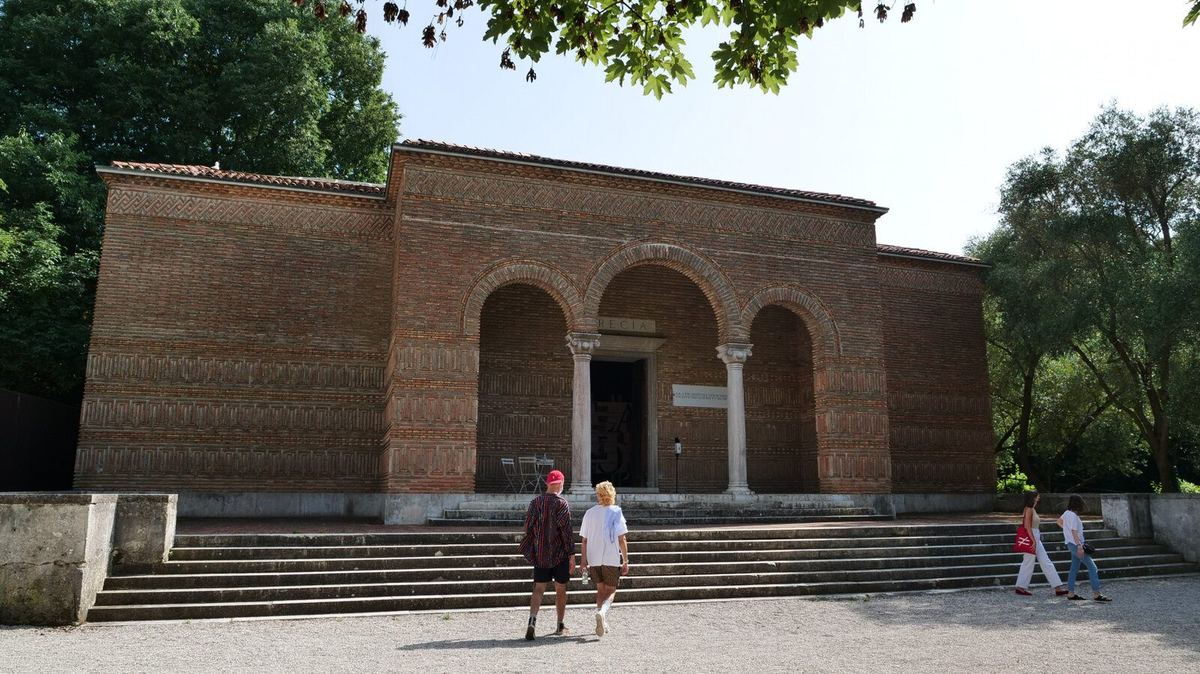
With Andreas Angelidakis' "ESCAPE ROOM", the Greek Pavilion transforms into a contemporary version of Plato's cave – an immersive installation at the intersection of physical space and digital illusion. Plato's allegory describes people chained in a cave who see only shadows on the wall – for them, this is the whole of reality; one prisoner frees himself, steps into the light, recognises the shadows as mere images, and on his return is met with disbelief: a picture of how tightly we cling to familiar images and how arduous, but also liberating, the path to new knowledge can be.
Angelidakis physically splits the pavilion in two – as an echo of the National Schism of 1915, when Greece was divided for two years into two rival states. One half is a bouzoukia stage, entirely digital, framed by Angelidakis' signature foam "pouf columns". The other follows an "alla turca" aesthetic, modelled on a souvenir kiosk. "Both must coexist," says the artist: "Ottoman Greece, and what we call the Romios – the one who came from abroad and supposedly knew better." At the entrance, a black fabric intervention pays tribute to Vaso Katraki – the artist won an award at the 1966 Venice Biennale and was later imprisoned for her political convictions.
"ESCAPE ROOM" freezes a year Angelidakis calls "Year Zero": 1934. That year, Hitler (90%) and Mussolini (99.85%) were confirmed at the polls; the two dictators met for the first time in person in Venice for the 19th Biennale, the Greek and Austrian pavilions were inaugurated, and the Nazi regime began the systematic persecution of homosexuals. Today, between the pavilion's columns, looping videos appear – Giorgos Marinos, Aliki Vougiouklaki as "Agent Nelly", stills from "Attack of the Giant Moussaka", fuchsia slogans like "Greece of the Greeks, Christian Greeks". Angelidakis calls the Giardini pavilions "Frozen Fascist and Colonial Caves" – frozen cells whose truth-mechanics today, in a "Phantasmagoria of Global Trumpism" and the 2025 MAGA staging of fascism, recall Plato's cave: "Replace the cave with the screen, and everything remains."
A seemingly harmless bathroom selfie pulls visitors deeper into a mirror room reflecting historical and present violence. The Athens-based artist, whose practice interlaces architecture, internet culture and exhibition design, choreographs a sequence of rooms in which perception, memory and fiction overlap. Curated by Giorgos Bekirakis, "ESCAPE ROOM" shows a present in which realities are structured according to game rules and "escape" often leads into frictionless virtual worlds – "an invitation", as Bekirakis puts it, "to view history not as something given but as an open field of interpretation".
Romania
With "Black Seas – Scores for the Sonic Eye", Anca Benera and Arnold Estefán transform the Romanian Pavilion into an "almost underwater" resonance chamber: a large-scale audiovisual and sculptural installation that thinks the Black Sea not as a fixed geography but as a plural, networked hydroscape – shaped by the rivers that flow into it, threaded with Europe's colonial, military and ecological histories, with currents that reach into the Mediterranean and the Adriatic and have historically connected the sea directly to Venice.
Two films, several sculptures and a sound layer build the pavilion into a two-level space: on the surface – controlled by geopolitical borders – and in the depth, where the Black Sea holds an anoxic, oxygen-free layer that, like a museum conservation chamber, slows the passing of time almost to a standstill. Organisms deposited in these sediments can enter a dormant state and "resurrect" centuries later under changed conditions – so-called resurrection ecology. To understand the future, here, means to travel back in time.
"Sound at the centre of a Romanian Pavilion contribution – that is a first," says Corina Oprea. From field recordings, compositions and vocal performances emerge scores for a "sounding eye" – the sea shifts from passive image to a speaking counterpart. "Also the voices that lie beyond the human," adds Diana Marincu. The display is explicitly designed with low-barrier access. Two further works are shown at Palazzo Correr in Cannaregio.
Poland
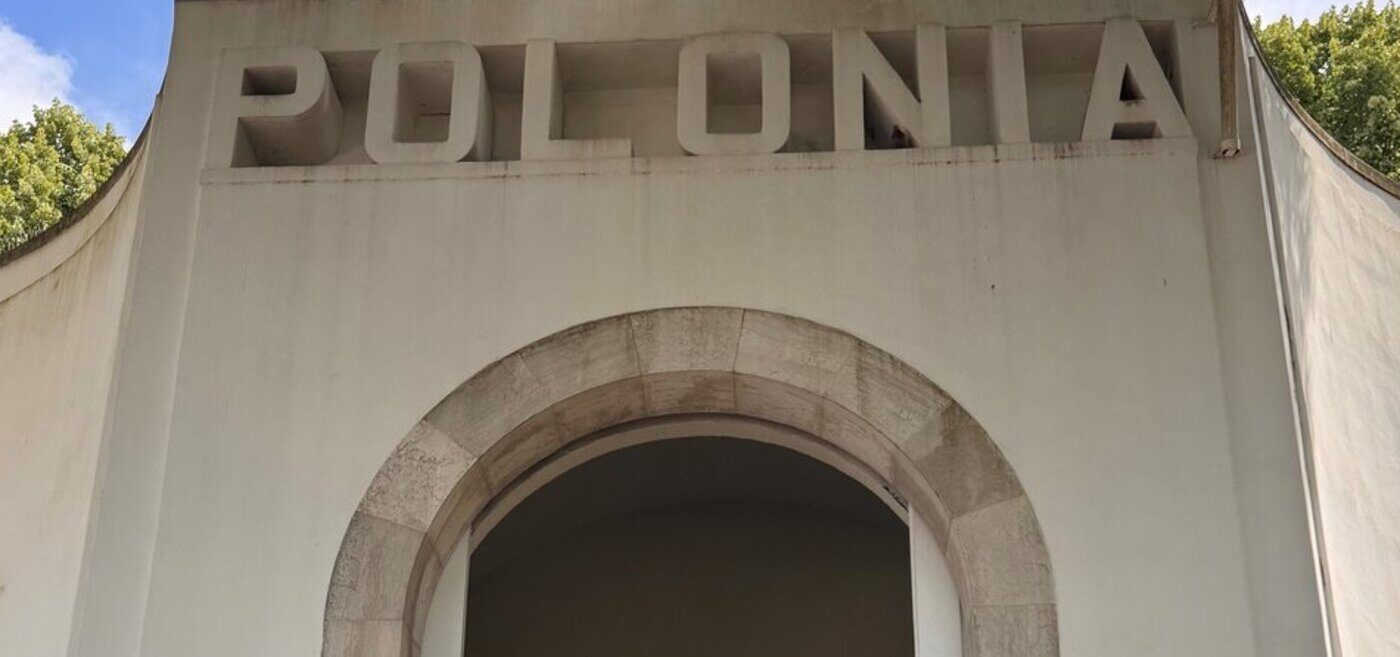
With "Liquid Tongues", Poland transforms its pavilion into an audio-video installation about marginal languages and "more-than-human" communication. Bogna Burska, Polish multimedia artist and playwright, works closely with Daniel Kotowski, a deaf artist and performer whose practice is devoted to the exploration of deaf experience and language. At the centre: the "Chór w Ruchu" (Choir in Motion), a mixed ensemble of deaf and hearing singers interpreting whale songs and whale communication – in English and in International Sign (IS).
Three days of shooting in a Warsaw indoor swimming pool form the film's foundation. In the pavilion, two video screens carry the footage – one hangs high under the ceiling so that the visitors' gaze lifts upward as if from the bottom of the pool. Underwater, the hierarchies reverse: where spoken language becomes distorted vibration, International Sign remains precise and unbroken.
The key concept is "Deaf Gain": a reversal of the conventional view of deafness, not as deficit but as autonomous culture and perceptual form. Woven into the video material is the story of American biologist Roger Payne, whose 1970 record "Songs of the Humpback Whale" made cetacean vocalisations widely audible for the first time – a sonic event that helped trigger the international anti-whaling movement. The choir's choreography, developed by Alicja Czyczel, follows the movement patterns of large fish shoals; Aleksandra Gryka's sound composition works with waves that evoke whale song and echolocation.
"Phonic language rules the Biennale, especially English," states Daniel Kotowski. "We have the opportunity here to articulate our perspective in International Sign – not in Polish sign language. English carries a linguistic hierarchy within it, IS does not." The work builds on the predecessor "Oddychaj" (Breathe, 2025, Łaźnia Gdańsk), in which Burska lost her voice underwater while Kotowski continued to sign unimpeded. A second strand of the film leads to Indigenous sign languages of North America whose origins reach back to 1400 BCE – a liquid tongue against the only few-hundred-year-old tradition of European sign-language research.
Venice Pavilion
With "Note persistenti" ("Persistent Notes"), the Venice Pavilion sees the lagoon city as a living organism, traversed by invisible memories, layers and vibrations. The project responds directly to Koyo Kouoh's leitmotif "In Minor Keys": like a composition in a minor key, the show invites visitors to listen to Venice's deeper frequencies – the notes that rise from the city's foundations, from the stories of its inhabitants, from the matter that sustains it.
The path unfolds as a sequence of rooms leading through four symbolic dimensions of the city: sommersa (submerged), domestica (domestic), mitologica (mythological) and collettiva (collective). Curator Giovanna Zabotti speaks of a "relational pavilion in which the works are not only looked at but activate connections between people, stories and perceptions". Her Venice manifests itself "through minimal, poetic signs – the light cast from the water onto the walls, the submerged parts, the intimate memories of those who live here every day".
At the opening on 8 May 2026, pianist and producer Dardust performed his piece "Sommersivo" – a work that will henceforth pass through the Venice Pavilion every 55 minutes. Conceived together with set designer Paolo Fantin (technical partner: H-Farm), it is divided into two acts; in the first, visitors can leave their thoughts on iPads and thus become part of the composition. The submerged note is entrusted by Zabotti to sculptor Alberto Scodro: sculptures of sand, glass, pigments and material residues that evoke sediments beneath the waterline. Commissioner Maurizio Carlin: "There is no need for spectacular gestures to be noticed, but for listening and bending down to the small things."
The domestic note is held by Ilya and Emilia Kabakov with "Diario veneziano" – the participatory large-scale project that, in parallel, has its main exhibition on the piano nobile of Ca' Tron (IUAV University, Grand Canal, 9 May – 28 June 2026). To an open call in January 2026, children, seniors, new citizens and families resident for generations from Venice's island city and the mainland responded: for four months, schools, academies and universities collected diary pages and objects – tools, photographs, fishing nets, plush toys – each story signed only with a first name, "because every story is a gift to the community". Cesare Biasini Selvaggi, who co-curates the section with Giulia Abate, calls the objects "not simply ready-mades, but resonance chambers of life". Three years after Ilya Kabakov's death, Emilia carries on the idea the couple first tried out in Ghent in 1993 – writing a new chapter of their nearly fifty-year relationship with Venice.
Artefici del nostro tempo. As in the past seven years, the pavilion also houses the winning works of the competition for young, emerging artists. Disciplines range from painting, photography, video and sculpture through glass design and public art (graffiti, street art, performance) to graphics and urban furniture design. Only unpublished works can be submitted. For 2026 the programme places an explicit focus on women artists – in keeping with Kouoh's call for a "radicality of joy" and attention to quiet, overlooked voices.
Egypt
With "Silence Pavilion: Between the Tangible and the Intangible", Armen Agop transforms the Egyptian Pavilion into a space of contemplation. Three rooms – sculptures and painting, primarily in granite – lead from the intangible through the tangible to what Agop calls the "mystic invisible". Visitors are asked not to speak and not to take photographs. Silence itself becomes material: not as absence but as presence – a conscious act of grounding in a time of global acceleration.
In the second room, darkness envelops the visitor, interlaced with a choreographed weaving of light, sound and scent. At its centre, a large elliptical painting in black from which a subtle luminosity emerges – the result of a process Agop calls "Gestural Mantra": ritualistic, repetitive marks made with the smallest pen nib, until the surface itself becomes a record of time and devotion. Beside it rests a circular black granite sculpture, inward, self-contained.
For over three decades Agop's practice has revolved around a few clearly set principles: sobriety, slowness, the rejection of demonstrative gestures. Inspired by the desert and ancient Egyptian sensibility, he distils his works to essential forms, free of narrative or representation. Sculptures become "traces" – recordings of time and consciousness, echoes of a spiritual process. Silence here is not absence but a generative force in which meaning gradually accrues.
Born in 1969 in Cairo, Agop graduated in 1992 from the Faculty of Fine Arts of Helwan University. His Egyptian-Armenian origin shapes the work in a twofold way: his grandfather survived the Armenian Genocide and found refuge in Egypt – Agop's participation as Egypt's representative thus carries a special biographical resonance of cultural coexistence and resilience. Today he lives and works in Italy.
Commissioned by the Egyptian Ministry of Culture and the Accademia d'Egitto a Roma, the pavilion fits precisely into Koyo Kouoh's leitmotif "In Minor Keys" – as "a contemplative counter-melody that speaks in minor keys through depth rather than volume". In 1995 Egypt received the Golden Lion for best national participation at this very site; in 2026 the pavilion sets quiet accents against the noise and immediacy of the present.
Serbia
With "Through Golgotha to Resurrection", Predrag "Pedja" Djaković shows a large-format cycle of works on 320 m² – paintings and installations supplemented by around 14,600 pieces of original archival material from the Archives of Vojvodina. The painter, born in 1964 in then-Yugoslavia (today's Bosnia and Herzegovina) and trained at the Academy of Fine Arts in Prague, has lived in the Czech capital for decades.
On the long wall, Djaković assembles photographs from personal family archives, anonymous portraits, maps, administrative documents and newspaper clippings into a fragmentary field of memory – without chronology, "resistant to narrative". Opposite, the suitcases pile up as a monumental sculptural accumulation: signs of forced mobility – deportations, exile, resettlements, impossible returns. The piano improvisation, performed by the artist himself, holds the space together emotionally. "Golgotha" and "Resurrection" are understood by the project, according to the curation, "not as religious motifs but as conditions" – an image of loss and possible transformation.
The project follows traces of European history, identity and ideology and asks how an individual survives under the weight of past and ideology. At its centre stands the idea that wounds can become "spaces of transformation" – the title's movement "through Golgotha to resurrection" as an image of historical trauma and its possible turning. Migration, memory and collective remembrance form the thematic bracket. The pavilion is curated by Tomaš Koudela and Olga Čučković.
The selection of Djaković has triggered controversy in Serbia: more than 600 artists, art historians and cultural workers signed a petition accusing the selection process of opacity and haste – the open call was only open for one month, no shortlist was published. Critics see the contribution as an expression of the government's cultural policy. Djaković and his curators, by contrast, understand the work as an "inner testimony" to Europe's historical traumas, intended to transcend national and political boundaries.
Austria
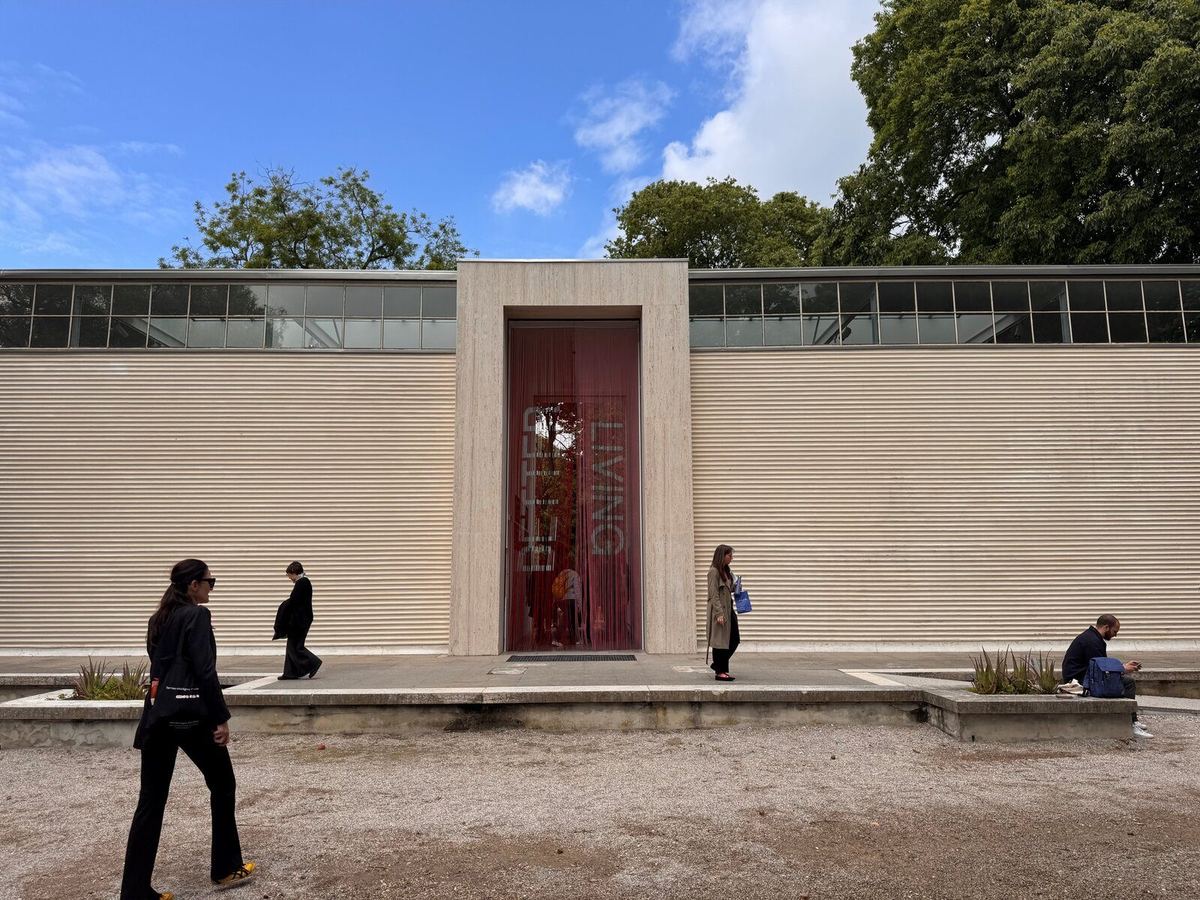
Developed specifically for the Austrian Pavilion and the Venetian lagoon, the project extends Holzinger's long-term research on water, feminist embodied reality and embodied risk. Based on mythological water figures and speculative futures, the work unfolds across installations and live acts, inviting the audience into an immersive landscape where choreography, theatre and performance meet. Provocative, physical and uncompromisingly direct, "Seaworld Venice" makes the pavilion a dynamic site of experience that connects contemporary performance with broader ecological, social and bodily questions.
"SEAWORLD VENICE" is three things at once: underwater theme park, sewage treatment plant and sacred building. A machine-like organism in which purity and pollution, guilt and atonement, nature and technology inevitably collide.
Inspired by Ophelia, sirens and mermaids, Holzinger imagines Venice as a feminist, amphibious city facing the climate crisis through resilience and collective transformation. Performers rise from the rubbish depths of the lagoon — making visible what turbo-tourism leaves behind and what the sea has long swallowed.
"Florentina Holzinger paints an apocalyptic scenario — one in which we already find ourselves. Living in the waste of others. Robotic hellhounds pointing the way to the future." — Nora-Swantje Almes, Curator of the Austrian Pavilion 2026
Holzinger's practice — committed to the legacy of Viennese Actionism and feminist body art — deconstructs images of femininity, dissects patriarchy and capitalism. In Venice she uses the fragility of the sinking city as a stage: as a metaphor for what we are all already in. The audience should prepare for the inevitable — they will get wet.