
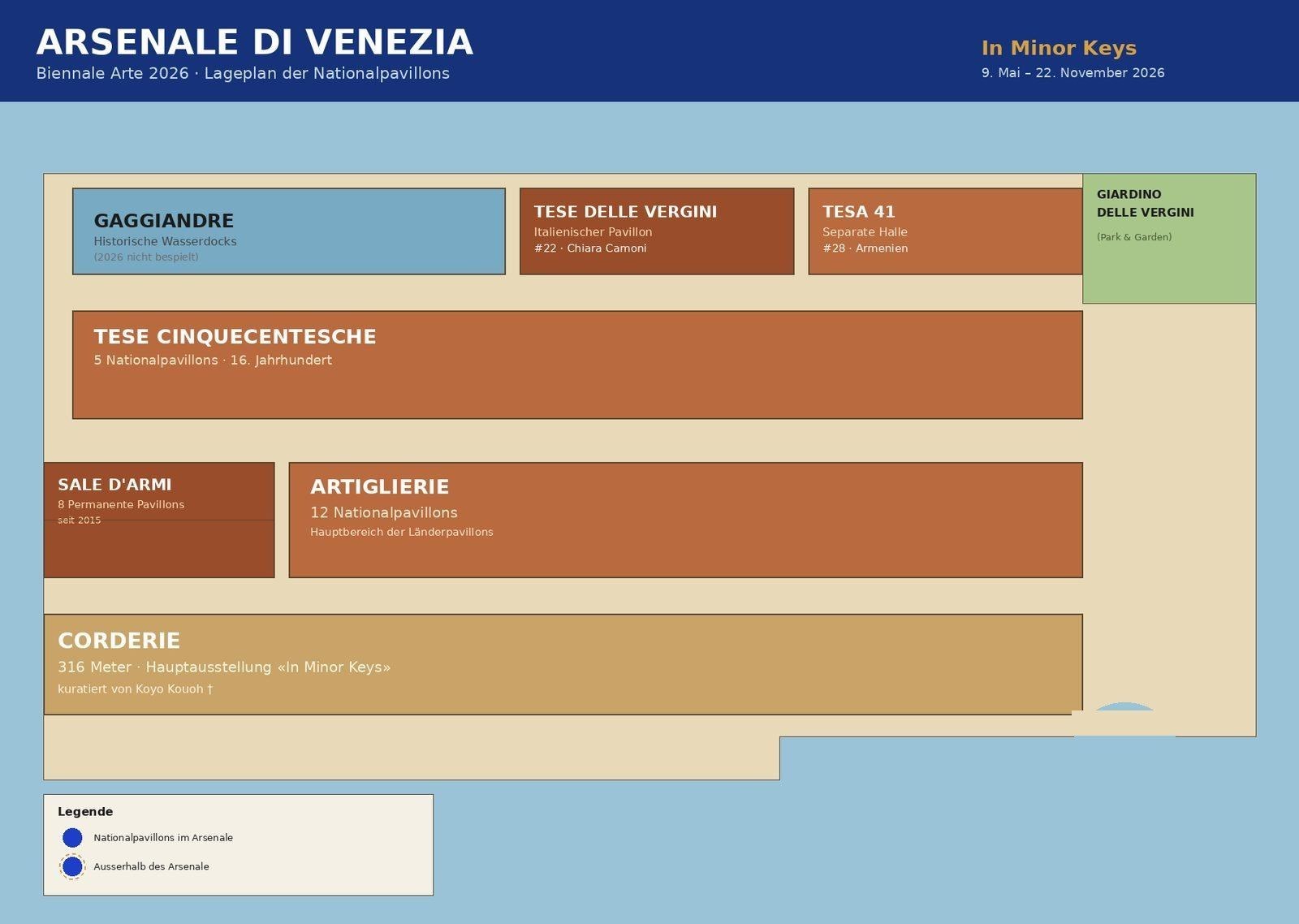
The national pavilions in detail
Corderie · Main Exhibition
The Corderie are the heart of the Main Exhibition at the Arsenale. Over more than 300 metres, Koyo Kouoh's "In Minor Keys" unfolds as a slow procession – works follow one another like stanzas of a composition in a minor key. Already at the entrance, flag banners by Alexa Kumiko Hatanaka flutter overhead. Indigo-blue fabric panels printed with poems – including by the Palestinian poet Refaat al-Areer – run as a blue thread through all the halls and "calm the senses at the dénouement of one phase and signal the opening of another", as the curatorial team puts it.
The hall opens with "khalil" (2026) by Lebanese-Australian artist Khaled Sabsabi: an eight-channel video installation on 13 × 13 metres, enveloped in the scent of black oud resin – fragmented layers of image and sound on the Lebanese diaspora and the history of displacement. Sabsabi is also the artist of the Australian Pavilion in the Giardini in 2026, with "conference of one's self" (curated by Michael Dagostino).
Deeper inside, Walid Raad shows "Postscript to the Arabic Edition, 1938–2025": eleven wooden pallets stood on end, with reproductions of Turkish and Arabic paintings painted on their undersides. Camouflaged contraband by Lebanese militias who, after the end of the civil war in 1990, sold their weapons on to actors in the Balkan war; the paintings were discovered only when the pallets were unpacked in a Ljubljana warehouse. Raad reconstructs that exact moment of unpacking, complete with tarpaulin backdrops, duct tape and printed A4 notes of an improvised display. Next to it, Cauleen Smith's "The Wanda Coleman Songbook" (2024) – a walk-in listening room with two deeply cushioned sofas, stacked Turkish carpets, a vinyl EP and poetry volumes by the Black L.A. poet Wanda Coleman; four screens show hazy footage from Los Angeles.
Other key works along the Corderie strand: Dan Lie's "Temple of Passages" (2026) – a large-scale installation of fragrant flowers knotted together with ships' rope, a direct nod to the cordage once spun in the Corderie for the Venetian fleet. Avi Mograbi's "Between a River and a Sea" (2026) sets two screens in dialogue – business directories of Beirut, Palestine and Syria from 1938 against the online Yellow Pages of Gaza from 2023: 80 years of economic life, erased. Guadalupe Maravilla's "ICE Age Disease Thrower" sculptures gather, in woven body-shaped seats, memorial objects from the artist's childhood flight from El Salvador to the USA. Laurie Anderson, Kader Attia, Alfredo Jaar and Rose Salane are also given dedicated rooms.
Rather than thematic halls, Kouoh structures "In Minor Keys" along five recurring "undercurrents": Shrines, Procession, Rest, Schools, Gardens. The Corderie embodies above all the Procession – South Africa's Wolff Architects (Cape Town) mark thresholds with floor-to-rafter indigo curtains floating between the constellations of works. The staging rewards lingering, not ticking off: visitors can sit down on the carpets that have been laid out, dwell at individual listening stations, return to particular works. Kouoh means the title literally – a conscious renunciation of orchestral pathos in favour of quieter frequencies, an exhibition that resists fast consumption.
Philippines
Jon Cuyson, an artist and filmmaker based in Manila, has spent more than two decades exploring themes such as labour, diaspora and queer ecology between painting and cinema.
In Sea of Love / Dagat Ng Pag-ibig, curated by Mara Gladstone, Cuyson creates an immersive environment of large canvases and videos dedicated to Filipino seafarers and workers on cargo and cruise ships along global routes. Images of ships, shells and water horizons become signs of distance and resilience, weaving life at sea together with that of families on land.
The canvases form a jagged horizon line meant to simulate the vision of a seafarer on the open sea. An oceanic love story unfolds from four perspectives: the sailor, his mother, his lover and the "sea of echoes". Images of ships, mussels and water horizons weave life on board with that of families on land. At the heart of the work stands Cuyson's own concept of "Mussel Thinking": the mussel – everyday food in the Filipino kitchen and a memory of his grandmother's cooking – becomes a philosophical model for permeability, care and community. Just as mussels cling to ship hulls and filter water, Filipino seafarers live in invisible swarms aboard the world's merchant fleet. The exhibition includes the short film "Sea of Echoes" (2026), produced especially for the Biennale in collaboration with mussel farmers and marine scientists at the University of the Philippines, as well as the earlier "Kerel (Sea of Love)" (2021) in black and white.
The Philippines provide more than a quarter of all seafarers worldwide – every second family in the country lives on remittances from abroad. The pavilion makes this invisible global labour visible.
Albania
"A Place in the Sun", curated by the Polish curator and art critic Małgorzata Ludwisiak and selected through an open call from 17 submissions, is a three-channel video installation in which live acting, puppetry, 3D animation and an original sonic score converge into a fictional theatre piece – staged in Zaum, the transrational experimental language developed by Russian Futurist poets in the early twentieth century as a "pure language" without grammar or syntax, intended to decompose the social order.
Korini's starting point is a forgotten avant-garde periodical from Petrograd (today Saint Petersburg): the magazine "Bloodless Murder" with its "Albanian Issue" (1916), which satirised the nationalist and imperial views of pre-revolutionary Russia on Albania – portrayed through a prism of exoticism, as a distant planet: "irrational, primordial, obscure, incomprehensible". Out of this material emerged the absurdist Zaum theatre play "Yanko I, the King of Albania", performed in a private studio in Petersburg. Korini takes up this history and uses the irrationality of Zaum to push language to its limit – to a place where anything can be said anew.
Genti Korini (b. 1979 in Tirana) works at the intersection of fiction and historical reality, past and present, perception and projection. His practice – across painting, moving image, photography and objects – examines the afterlives of modernity, modernisation, post-communism and the neoliberal present as unstable conditions rather than fixed narratives. His film "Spider's Envy" was shown at Manifesta 14 (2022).
The work reads Albania as a "somewhere place" – a place continuously rewritten by both foreign and internal projections. At the same time, the show becomes a poetic mouthpiece for all "invisible cultures and minor languages": in the disintegration of meaning that Zaum's irrationality performs, contemporary questions resonate – about populisms, new nationalisms, future anxieties and the possibility of thinking the self beyond orientalising clichés.
Slovenia
"Soundtrack for an Invisible House", curated by Nataša Petrešin-Bachelez and developed by the Nonument Group, is a sound installation in the Arsenale built literally on rubble: the floor is composed of the crushed remains of the pavilions from the previous Architecture Biennale. Visitors are invited to settle among the concrete debris and listen. Over the seemingly empty space drifts a polyphonic composition (Gašper Torkar, with the vocal group Vokum) in four languages – Slovenian, Bosnian, Hungarian, Italian – interspersed with birdsong, wind and the sound of running water.
The starting point is a little-known episode of the First World War: in 1917 the Austro-Hungarian Army built a temporary wooden mosque at Log pod Mangartom, near today's Slovenian-Italian border, for the Bosnian Muslim soldiers fighting on the Isonzo Front – religion harnessed to politics, propaganda and imperial military infrastructure. After the war the building vanished without trace. Only archaeological excavations from 2022 onwards brought the remains to light; in 2025 the site was officially recognised as cultural heritage.
Set amid the historic Arsenale – a symbol of centuries of Venetian military and maritime power – the Slovenian Pavilion poses questions about religion, war and dignity at a time when "genocide is turned into spectacle" (in the collective's own words). The shifting identities of European Muslim communities in the 20th and 21st centuries are woven into sound and space. ArtReview called the pavilion a "balm" amid the pomposity of the Biennale – not a reconstruction but an act of "attunement" to the afterlives of empire and war.
Kosovo
"Strong Teeth", curated by the Mexican curator José Esparza Chong Cuy, revolves around a 17-metre-long landscape painting by the Kosovar painter Brilant Milazimi. It shows a dense crowd of people moving across a mountain silhouette – an allusion to the rural regions of Kosovo. The figures wait with clenched teeth; the title is to be taken literally: tension gathered in the body, stored in the jaw, etched into the enamel. Built up in dominant tones of red and blue, the painting becomes an immersive staging of a collective state of waiting.
The pavilion reads waiting as a political and psychological condition – between instability, transition, uncertain statehood and open future prospects. The lines of people recall today's refugee movements (Ukraine) as much as Kosovo's own history of the late 1990s.
Brilant Milazimi (b. 1994 in Gjilan, living between Gjilan and Pristina) is considered one of the most promising voices of the younger Kosovar artist generation. His paintings show a bitter, poetic world: exaggerated physiognomies, animal presences and the recurring motif of clenched teeth – ciphers of unresolved social tensions, drawn from the logic of the unconscious and a fictional pictorial force.
The pavilion is exceptionally not housed in the Arsenale but in the Church of Santa Maria del Pianto – a Baroque octagonal church built between 1647 and 1658 to designs by Francesco Conti, located on the northern lagoon of Venice, about 1.5 km from the Arsenale. The deserted sacred building, once a monastery, lends the staging of waiting and stillness a contemplative charge. Esparza Chong Cuy understands the work not as a solution but as an invitation to close observation – "to remain in the face of what is shown".
Latvia
"Untamed Assembly: Backstage of Utopia", curated by Inga Lāce (MoMA New York) and Adomas Narkevičius (Kaunas Biennial 2025), stages the Latvian Pavilion as a backstage – a space of preparation, invisible labour, improvisation and collective imagination, where utopias are rehearsed before they reach the stage. The clothing rack functions as a central architectural element, complemented by recurring bird motifs and textile sculptures – ciphers for flight, risk and fragility. Newly digitised footage from Bruno Birmanis's archive weaves together border-crossing, transnational community, scarcity as a driver of creativity, and the fragile political freedom of the early 1990s.
The starting point is the cult interdisciplinary platform Untamed Fashion Assemblies (UFA), which between 1990 and 1999 in Riga fused fashion, performance, drag, stagecraft and visual art into a post-Soviet gesture of freedom – beyond Soviet ideology and beyond Western market logic. On the same stages, young Baltic designers like Birmanis, Juozas Statkevičius and Sandra Straukaitė met figures such as Paco Rabanne, Vivienne Westwood, Zandra Rhodes and Andrew Logan; Viktor & Rolf passed through the Assemblies as students. For a brief moment international media celebrated Riga as an "unexpected avant-garde hub".
Bruno Birmanis (b. 1962), Latvian fashion and interior designer, founder of UFA and co-author of the Postbanalism Ball of 1988 – the first alternative fashion performance in the then-USSR; later director of the fashion weeks in Vilnius and Moscow. The designer duo MAREUNROL'S (Mārīte Mastiņa-Pēterkopa and Rolands Pēterkops, founded in Riga in 2012) works at the intersection of fashion, performance and visual art – with textile sculptures, video and sound art – and was among the ten European nominees for the International Woolmark Prize in 2016, as well as the first Latvian label in the official programme of Paris Fashion Week.
The pavilion, organised by the Latvian Centre for Contemporary Art (Commissioner: Solvita Krese, Architecture: Līva Kreislere), does not return to UFA out of nostalgia but asks: what utopian visions can be drawn today from these festivals? How are collective imagination, desire and visibility produced when political and economic systems are in transition – and what forms of being together are rehearsed "backstage" before they step onto the main stage?
North Macedonia
"Pietà in the Emergency Blankets / Will My Eyes Be Closed or Open?", curated by Tihomir Topuzovski and Amanda Boetzkes, is a sculpture installation by the Skopje-based artist Velimir Zhernovski. The work reimagines Michelangelo's Pietà – not as a monumental icon of mourning from the past, but as a "living, unsettled form" that speaks to the present. Instead of marble, the figures are wrapped in golden emergency blankets – the foil rescue blankets familiar from images of Mediterranean rescues. North Macedonia's Ministry of Culture calls them "at once both protection and alarm" – "a beauty that hurts".
Beyond the classical motif of mourning, the pavilion addresses urgency, vulnerability and the politics of the body – themes of sexuality, identity and visibility that have long shaped Zhernovski's practice. The work was selected by a jury for its "conceptual clarity and visual force"; classical pictorial tradition and global present are meant to intertwine.
The pavilion is not housed in the Arsenale, but in the Ex Cappella Buon Pastore (Castello 77) – a historic sacred space in Venice's Castello district. The quiet, spiritually charged atmosphere amplifies the work's effect: a bridge between past and present, between the intimate and the universal.
Sultanate of Oman
"Zīnah (Adornment)", curated and designed by Haitham Al Busafi, is a spatial installation in the Arsenale Artiglierie: visitors enter through a darkened passage and arrive on a field of Omani desert sand, beneath a canopy of delicate silver forms. With every step, the metal elements sway, softly colliding and generating a constantly shifting soundscape. Paths form in the sand, dissolve, are redrawn – the work lives through the movement of its audience.
The starting point is the Omani tradition of Al-Zaanah – the silver horse adornment in which horse and rider are equally adorned as a gesture of mutual dignity. "A culture that adorns its horses refuses to treat any companion as a mere instrument, but as an extension of the self," says Al Busafi. Adornment here is understood not as possession or display, but as an ethical act of recognition – an ethics that encompasses human encounter, animal and environment alike.
In a workshop in Muscat, students and emerging artists contributed their drawings on relation and recognition – these are engraved on the silver objects and carry multiple voices into the work. With this, the pavilion responds directly to the Biennale's theme "In Minor Keys" by the late curator Koyo Kouoh: rather than spectacle, "Zīnah" seeks quiet intensities – friction, shimmer, breath, sound – and is explicitly dedicated to her vision.
Haitham Al Busafi (b. 1985 in Muscat) works as artist, architect and curator at the intersection of architecture, art and technology. Trained at the University of Applied Arts Vienna (die Angewandte), he was shaped by teachers such as Zaha Hadid, Kazuyo Sejima and Hani Rashid. He is the founder of Beyond.xyz, a virtual production studio in Saudi Arabia that bridges physical and digital spaces through real-time technologies.
Morocco
"Asǝṭṭa (Threshold)", curated by Meriem Berrada (MACAAL Marrakech), is a monumental textile installation in the Arsenale Artiglierie: more than 150 vertically woven wool panels, produced by 166 artisans from across Morocco – from the Middle Atlas to the Souss-Massa region. Wool forms the weft, supplemented by woven fibres of palm-leaf raffia; each panel is hand-stitched. The panels hover as a suspended, translucent membrane in the space – a second skin one walks through.
At the conceptual core is the âatba – the threshold in Moroccan vernacular architecture, the charged passage between inside and outside, private and public, sacred and profane. Agueznay, trained as an architect, translates this element of her own discipline into textile form: a step through the work becomes a passage between inside and outside, past and present. The title Asǝṭṭa comes from Tamazight and means ritual weaving – traditionally a spiritually feminine practice in which the woven form itself is understood as a living being.
Amina Agueznay (b. 1963 in Casablanca), daughter of the painter Malika Agueznay, studied architecture in the USA and returned to Morocco in the late 1990s. From jewellery design grew her present-day textile practice, which for more than twenty years has developed through close field research with Moroccan weavers, embroiderers and metal artisans. Morocco's first ever national pavilion is programmatically entrusted to a female artist and a female curator – selected from 29 submissions by a jury chaired by Mehdi Qotbi.
Ireland
"Dreamshook", curated by Georgina Jackson (Douglas Hyde Gallery, Dublin), presents Isabel Nolan's work in the Arsenale (Campo de la Tana) with hand-tufted tapestries, sculptures, drawings and a curtain. The title names the threshold moment of waking, when reality is destabilised and realms of possibility linger and dissipate. At the centre is a pair of large-scale arched tapestries featuring apparitions; nearby "Dreamshook" (2026) – an unyielding bed adrift on an unstable floor – and "Oh!" (2026), a curtain that paradoxically seems both still and in motion.
The starting point is the figure of the Venetian printer and publisher Aldo Manuzio (Aldus Manutius, c. 1450–1515), who revolutionised European reading culture: he introduced the semi-colon and italics and produced portable pocket-sized books (enchiridions) – precursors of the modern paperback. The central tapestry "Aldus Dreams of a Plentiful Supply of Good Books" (2026) imagines his dream with nods to the art and architecture of the early Renaissance. Nolan draws on this history to interrogate the "architectures of belief and knowledge" we inhabit – and how often they stretch the limits of credibility.
The work interweaves late Middle Ages and early Renaissance, humanism, religious and mythological narratives with experiences of mortality and love; the Book of Kells and 13th- and 14th-century architecture also resonate. Nolan herself describes the show as "an exhibition about ambivalence" – about the western, classically inflected, enlightened tradition she "both hates and loves". In the translucent materials and the shifting of large fabrics into the intimate, the pavilion answers the Biennale theme "In Minor Keys": a work that oscillates between the tangible and the imagined, letting dreams press insistently on reality.
Isabel Nolan graduated from the National College of Art and Design in Dublin in 1995 and was already part of Ireland's Venice contribution in 2005. She has exhibited internationally at venues including Château La Coste, the London Mithraeum (Bloomberg Space), Grazer Kunstverein and the Irish Museum of Modern Art, and is represented by the Kerlin Gallery, Dublin. The pavilion is commissioned by Culture Ireland in partnership with The Arts Council / An Chomhairle Ealaíon; the producer is Cian O'Brien (COBA). After Venice, "Dreamshook" will tour Ireland nationally in 2027.
Chile
Chile presents "Inter-Reality" in the specially reopened Sala dell'Isolotto in the Arsenale (approx. 280 m²). Norton Maza stages a white, room-filling sculpture that resembles a stranded spaceship, with a staircase that seems to promise access but leads nowhere. Visitors take off their shoes at the entrance and enter the pavilion barefoot on a white floor – this minimal intervention alone slows the body before the gaze even sets in.
Through small openings, handcrafted hyperrealistic dioramas become visible inside the central object: micro-worlds in which references to classical European painting collide with contemporary subjects – migration, fake news, cultural violence, ecological devastation. An almost human, hyperrealistic presence brings an unsettling "uncanny valley" moment into the otherwise ascetic white space. The sound layer works with the timbres of vanished indigenous peoples of Chile, offering a memory that is not absent but in dialogue with the present.
Norton Maza (b. 1971 in Lautaro, Araucanía Region) was exiled to France with his family in 1975, after his father had been imprisoned for two and a half years following the Chilean military coup. In 1980 he moved to Cuba, graduated in 1989 from the National School of Art (ENA) in Havana, and continued his studies until 1994 at the École des Beaux-Arts in Bordeaux. He now lives and works in Santiago de Chile. The pavilion is commissioned by the Chilean Ministry of Culture; co-curators are Marisa Caichiolo and Dermis León, with production led by Claudia Pertuzé.
United Arab Emirates
"Washwasha" – an onomatopoeic Arabic word for "whispering" – transforms the UAE's permanent pavilion in the Sale d'Armi at the Arsenale into a sounding instrument. A sequence of chambers designed by Büro Koray Duman (B-KD) Architects guides visitors from intimate listening situations through increasingly overlapping sound spaces full of interference and constant communication. Sound here serves not as illustration but as method: as a gateway to the intangible, to memory, language, body and identity.
Six artists, born in Abu Dhabi, Dubai, East Jerusalem and Moscow, present newly commissioned and existing works: Mays Albaik, Jawad Al Malhi, Farah Al Qasimi, Alaa Edris, Lamya Gargash and Taus Makhacheva. Makhacheva's "And What Did You Say?" (2026) gives gossip a physical life – with a bench, a 30-minute audio piece and a performance structure of three characters: Source, Spread and Core. Edris's "Wisws" (2026) approaches the term in Emirati colloquial dialect as interference and noise. Al Qasimi works with large-format vinyl imagery, photography and film; Gargash's practice documents overlooked spaces of Emirati everyday life.
The pavilion situates contemporary practices within a continuum of acoustic self-representation – from oral storytelling traditions and poetry circles to locally initiated broadcasting and digital listening cultures. A "Voice of the Country" activation honours Salem Obaid Alaleeli, who founded Ajman Radio in 1961. The UAE today is home to more than 200 nationalities; the work presents the country not as a fixed cultural form, but as a space shaped by mobility, correspondence and layered modes of listening.
Bana Kattan, Curator and Associate Head of Exhibitions at the Guggenheim Abu Dhabi Project, curates the UAE's ninth Biennale participation – assisted by Tala Nassar. Kattan was previously Associate Curator at the Museum of Contemporary Art Chicago and at NYU Abu Dhabi Art Gallery; she was born in Abu Dhabi. The pavilion is commissioned by the Salama bint Hamdan Al Nahyan Foundation; the UAE's Venice Internship Programme is in its 15th year – two alumnae (Edris, Albaik) are among the exhibiting artists.
Saudi Arabia
"May your tears never dry, you who weep over stones" – curated by Antonia Carver (Director of Art Jameel) with Assistant Curator Hafsa Alkhudairi – is Dana Awartani's most ambitious work to date. In Saudi Arabia's permanent pavilion in the Arsenale, a room-filling floor installation unfolds: 29,000 hand-formed clay bricks in four differently coloured clay earths sourced from distinct regions of the Kingdom – not kiln-fired, but baked in the sun. Together the bricks form mosaic patterns that visitors traverse along narrow paths.
The geometric, floral and faunal motifs cite 23 cultural heritage sites across the Arab world and the Mediterranean that in recent years have been severely damaged or destroyed by war and violence – from the Bureij Mosaic in Gaza and the Raqqa Museum in Syria to the Hamam al-Sammara in Gaza (14th century) and the Great Mosque of Aleppo. Mosques, churches, synagogues and secular buildings are deliberately evoked alongside one another: "It's not about pointing the finger at one group – these are all war crimes, whoever commits them," says Awartani. The mosaics of Syria, Lebanon and Palestine share a formal language that has evolved over more than 3,000 years – the work makes this common cultural heritage visible.
Awartani worked with 32 Saudi-based master artisans – many of them from the Arab world and South Asia – in a studio site in the mountains outside Riyadh. The bricks were produced over more than 30,000 hours of work; the traditional binding agent of hay was deliberately omitted so that as the bricks dry, fine cracks run through the patterns, keeping the vulnerability of the material and of the sites palpable. This "many hands" ethos also runs through the discursive programme, with contributions from Shumon Basar, Rachel Dedman, Uzma Rizvi, Amer Shomali, Dima Srouji and Sumayya Vally, among others.
Argentina
"Monitor Yin Yang" turns the Argentine pavilion in the Arsenale into a traversable landscape of white salt and black charcoal. On entering, visitors are instructed to follow narrow white paths winding through a billowing, snow-white salt field marked with drawings in black charcoal. As one moves through the darkened, almost cinematic space, the surface shifts beneath each step, and the image changes over time. Salt, says Duville, "evokes ancient seas and their memories"; charcoal carries traces of burnt organic matter.
The title refers not only to the contrast between black and white, but to a whole series of tensions: between the invitation to wander and the instruction to keep to the path; between the soft, impressionable surface and the weight of the bodies traversing it; between volition and regulation. Across the salt surface unfold pictorial scenes that slide natural forces and traces of civilisation into one another: flowing waterfalls, eroding winds, cabins, keyboards, vehicles – as if moving through a vast, post-apocalyptic Patagonia.
A multilayered sound composition runs through the pavilion: it was developed by Centolla Society – the collaboration between Matías Duville and his brother Pablo Duville – in partnership with composer Alvise Vidolin and the Centre for Computational Sonology (CSC) at the University of Padua. Real-time environmental data from Venice – atmospheric conditions and air quality – are translated into variations of density, intensity and movement and woven together with the sound of footsteps on the salt. Drawing, sound, urban data and human presence converge into a constantly evolving sonic image.
Mexico
"Invisible Acts to Sustain the Universe" ("Actos invisibles para sostener el universo"), curated by Jessica Berlanga Taylor, turns the Mexican pavilion into a sensorial environment of sound, clay, salt, gesture and breath. A salt line shaped as a Mesoamerican vírgula (spiral) guides visitors through the space, where ceramic vessels, tobacco references and audiovisual works unfold as "interconnected acts of care and remembrance". Rather than reconstructing ancestral systems, the installation approaches material itself as a carrier of memory and cosmology.
The name RojoNegro condenses the project's stance: red and black are sacred colours and cardinal points in Mesoamerican cultures; they refer to the ink of pre-Columbian codices in which the "rule of life" – the balance between humans and the cosmos – was transmitted. The duo's practice treats Indigenous and Afro-descendant cosmogonies not as folklore or external reference, but as living matrices of thought that shape creation, connection and imagination. The staging seeks, in Berlanga's words, "to slow down and enable a deep listening to the crises we are all living through".
The exhibition is conceived as a ritual offering (ofrenda) – a political act that shifts power from the individual to the collective. It takes the body as an archive of memory seriously and builds a bridge between living Mesoamerican knowledge systems and a present in which accelerated capitalism destroys natural worlds as well as the epistemologies that would enable different forms of coexistence. The pavilion thus responds directly to the Biennale theme "In Minor Keys" as conceived by the late artistic director Koyo Kouoh: Indigenous knowledge, says Berlanga, is "very much alive – in this past lies a sustainable future".
RojoNegro was founded by María Sosa (b. 1985 in Morelia, Michoacán) and Noé Martínez (b. 1986 in Morelia, Michoacán). Sosa studied at the Universidad Michoacán de San Nicolás de Hidalgo; her research draws on pre-Columbian art, anthropology and the Ecología de Saberes. Martínez is a visual artist and filmmaker trained at the Escuela Nacional de Pintura, Escultura y Grabado "La Esmeralda" in Mexico City; his own family history feeds into the work as ethnographic case study.
Ukraine
"Security Guarantees" unfolds across two locations: At the entrance to the Giardini, Origami Deer (2019) by Zhanna Kadyrova is suspended in the air from a truck-mounted crane – a massive concrete sculpture of a deer in origami folding, constantly "between evacuation and uncertainty". Inside the Ukrainian Pavilion in the Sale d'Armi (Building A, 1st floor) at the Arsenale, the exhibition presents archival material on the Budapest Memorandum and a multi-channel video documentation of the sculpture's evacuation from Pokrovsk and its journey across Europe (with the participation of Natalka Dyachenko, Pavel Sterec, Max Maslo).
Kadyrova created the deer in 2019 together with Denys Ruban for a park in Pokrovsk (Donetsk Oblast) – on the pedestal of a dismantled Soviet nuclear-capable jet. A symbol of military power was thus transformed into a work that preserves memory while also resetting it. In August 2024, as the Russian front line approached Pokrovsk and the civilian population was evacuated, Kadyrova, co-curator and historian Leonid Marushchak, specialists and municipal workers dismantled the sculpture – originally conceived for a fixed location – and brought it to safety. Before Venice, the work travelled through Warsaw, Vienna, Prague, Berlin, Brussels and Paris – in Brussels presented near the European Parliament and the Bozar, among other sites.
The title refers to the Budapest Memorandum of 1994, in which the United Kingdom, the United States and Russia provided security assurances – in exchange Ukraine renounced its nuclear arsenal entirely by 1996 (at the time the third largest in the world). "These guarantees were supposed to protect us," says Kadyrova. "They existed only on paper." In the words of co-curator Kseniia Malykh: "Security guarantees existed on paper, while life, both human and cultural, repeatedly faced the need to rescue itself." The suspended deer becomes a "symbol of the uncertainty in which millions of Ukrainians live".
Zhanna Kadyrova lives and works in Kyiv and is considered one of the most important voices of her generation. She is a laureate of the Taras Shevchenko National Prize of Ukraine (2025), winner of the first Her Art Prize founded by Marie Claire France and Art Paris (2025), of the PinchukArtCentre Prize (2013) and the Kazimir Malevich Prize (2012). The pavilion is curated by Ksenia Malykh and Leonid Marushchak; the public programme is curated by Katia Khimei and Ivanna Kozachenko. Commissioner is Tetyana Berezhna, Ukraine's Deputy Prime Minister for Humanitarian Policy and Minister of Culture.
Lebanon
"Don't Get Me Wrong" turns the Lebanese pavilion in the Arsenale (Artiglierie, Campo della Tana 2169/F) into an immersive resonant space: a 45-metre frieze of 26 acrylic-on-canvas panels by Nabil Nahas. The format echoes the narrative ribbons of the temples of Baalbek and the Parthenon, but follows the non-linear principles of Persian miniature painting: each panel stands on its own yet groups associatively with its neighbours to allow multiple readings. The hanging two metres above the floor follows a Renaissance principle from churches and palaces – no one obstructs the view, the eye must travel upwards.
The compositions combine geometric abstraction, Islamic patterns, Sufi spirals, fractals and figurative natural motifs – cedars, olives, star shapes (both natural and man-made). Nahas weaves the cultural layers of Lebanon into a "sensitive topography" of the country: Greco-Roman, Judeo-Christian, Byzantine and Islamic influences – the millennia-old sediments that to this day shape the identity of the cedar homeland. Curator Nada Ghandour: "It is a combination of art, culture and spirituality – at once symbolic and philosophical. Unlike conventional friezes, Nahas does not tell a linear story: each painting is different, yet somehow connected."
Nabil Nahas (b. 1949 in Beirut) grew up between Beirut and Cairo, studied in New York and now divides his time between the USA and his studio in the Lebanese mountain village of Ain Aar – after 18 years of exile he was able to return for the first time only after the end of the civil war. With more than five decades of practice he is one of the most internationally recognised Lebanese-American painters; his works are held in the collections of the Metropolitan Museum of Art, the Guggenheim and the British Museum. "Don't Get Me Wrong" is the sum of this engagement with abstraction, texture and cultural memory.
Luxembourg
"La Merde", curated by Stilbé Schroeder (Casino Luxembourg), transforms the Luxembourg Pavilion in the Arsenale (Sale d'Armi, 1st floor) into an immersive audiovisual space. At its centre is Aline Bouvy's first feature film: a cinematographic essay whose protagonist is a female-coded anthropomorphic excrement – embodied through a mix of live actors (Marie Bos, Damien Chapelle, Lucie Debay, Marc Guillaume, Louise Manteau) and 2D animation (Lora D'Addazio). The film is projected on a 4.5 × 2 m LED screen, embedded in a mirror-glassed steel architecture and a 4D sound system.
The work can be read as a feminist manifesto in film form, dissecting shame as a social construct and exposing the thresholds at which bodies are "classified, tolerated, disciplined or pushed out of view". Bouvy makes explicit reference to Julia Kristeva's "Powers of Horror: An Essay on Abjection" (1980). At its centre is the question of how societies produce bodies over which they demand control and restraint – and what systemic violence shapes lives and behaviour.
The seating in the pavilion is a semicircular, soundproofed bench with mirrored stainless-steel surfaces – a newly adjusted version of Bouvy's work "Wall", first shown in her exhibition "Hot Flashes" (2025) at Casino Luxembourg. The mirror architecture reorganises the position of viewers in the space, both physically and socially: anyone who looks sees themselves and the others together with the work in the frame.
Aline Bouvy (b. 1974 in Watermael-Boitsfort, Belgium) lives and works between Brussels and Luxembourg and studied at the École de Recherche Graphique (ERG) in Brussels and the Jan van Eyck Academie in Maastricht. Her 25-year practice questions social structures, normative systems and the mechanisms that regulate behaviour and desire – with "a precise formal system, rigorous aesthetics and a decidedly off-kilter sense of humour".
Singapore
"A Pause", curated by Selene Yap, transforms the Singapore Pavilion in the Arsenale (Sale d'Armi, 2nd floor) into a space for rest and observation. Amanda Heng focuses on seemingly ordinary actions: sitting, waiting, watching. The work brings together three elements: an architectural intervention in larch wood – the same timber from which the floorboards of the Arsenale and the foundations of Venice are made –, a new video work (2025–26) filmed with Venetian participants going about everyday pause rituals (watering plants, preparing breakfast, looking up at the sky), and the re-issued photo series "Parts of My Body" (1990, reprinted 2026) of unadorned close-ups of her own body.
Heng describes the work as a "site-specific installation and durational performance" in which visitors are invited to take part: there is no fixed path; each person moves through it differently. "A Pause" asks about rest as a necessity, about the inner stillness from which resilience and renewal arise. Curator Selene Yap describes a movement "away from the charged immediacy of live performance towards a slower, more interior mode of attention" – aligned with the Biennale theme "In Minor Keys".
Amanda Heng Liang Ngim (b. 1951) has been a foundational voice in Singaporean contemporary art since the late 1980s. Originally trained in printmaking, she developed a feminist performance practice – iconically a public march of women carrying high-heeled shoes in their mouths. In 1999 she founded "Women In The Arts", Singapore's first artist-run women's collective; in 2010 she received the Cultural Medallion (Singapore's highest arts honour), in 2020 the 12th Benesse Prize, and in 2023 was inducted into the Singapore Women's Hall of Fame. At 74, she is the oldest artist ever to take over the Singapore Pavilion in Venice – and only the second woman in this role, after Shubigi Rao (2022).
Turkey
"A Kiss on the Eyes" – curated by Başak Doğa Temür, coordinated by the Istanbul Foundation for Culture and Arts (İKSV) – presents Nilbar Güreş in the Turkish Pavilion at the Arsenale. The title is a Turkish letter-closing phrase, a gesture of warm affection. Güreş works with fabric, macramé, wool, thread, steel and copper – all produced in Istanbul workshops with sculptors, metalworkers, tailors and craftspeople. Within the space, sculptures hang, lean and hover – quietly, almost vulnerably – making visible the invisible structures that govern our bodies and movements.
Female figures with women's heads and spider bodies, tropical trees draped in transparent evening dresses, climbing plants made of fabric and copper wire winding through the space – Güreş creates a world in which humans, animals and plants intermingle. Her work draws on personal biography while addressing the larger questions of gender, social roles, cultural identity and the often invisible codes that shape them. Softening the gaze, the pavilion proposes, is itself a political act.
Nilbar Güreş (b. 1977 in Istanbul, of Kurdish-Turkish heritage) studied painting at Marmara University Istanbul, completing a Master's at the Academy of Fine Arts in Vienna and further studies in art and textile pedagogy at the University of Applied Arts Vienna. She lives between Istanbul, Naples and Vienna. Her works are held in the collections of MAXXI Rome, the Palais de Tokyo Paris, the Van Abbemuseum Eindhoven and the Malmö Konstmuseum; internationally she has shown at the Berlin Biennale 2010, in São Paulo 2014, Sydney 2016 and Yokohama 2020, among others.
Peru
"Sara Flores. From Other Worlds (De otros mundos)" – curated by Issela Ccoyllo and Matteo Norzi – marks Peru's first presentation at the Art Biennale under the leadership of an Indigenous artist. In the Arsenale pavilion, Sara Flores presents three new bodies of work: large-format paintings on wild cotton (including the largest kené painting of her career, on which she worked daily for four months), ethereal, mosquito-net-shaped sculptures of hand-painted cotton (Untitled / The Designs Come in Dreams), and her first film "Non Nete (A Flag for the Shipibo Nation)" (2025) – a sustained image of a hand-painted cloth moving in the wind.
At the heart of the work is kené, the visual and cosmological language of the Shipibo-Konibo people of the Peruvian Amazon: not decoration, but a knowledge-map, a practice of repair, and a link between body, land and cosmos. The geometric patterns are transmitted matrilineally – from mother to daughter – and applied to cloth with plant pigments sourced in the forest. The pavilion is filled with the sounds of insects and birds; the film's soundtrack carries a whistled melody blown by a shaman into an ayahuasca bottle – the opening of a journey to "other worlds".
Sara Flores (Shipibo name Soi Biri = "well done / precisely drawn") was born in 1950 in the Shipibo-Konibo community of Tambo Mayo on the Ucayali River in the Peruvian Amazon and now lives in Pucallpa. She learned kené from her mother from an early age; to this day she works closely with her daughters. International recognition came among other ways through a collaboration with Dior for the Lady Dior Art Project; in 2025 she became the first Shipibo-Konibo artist to have a solo exhibition at the Museo de Arte de Lima (MALI).
Uzbekistan
"The Aural Sea" – curated by the inaugural cohort of the Bukhara Biennial Curatorial School (Sophie Mayuko Arni, Aziza Izamova, Kamila Mukhitdinova, Nico Sun, Thái Hà) under the leadership of Diana Campbell – is located in the Arsenale (Castello, Quarta Tesa) and engages one of the most dramatic environmental catastrophes of our time: the Aral Sea in Karakalpakstan. Since the 1960s, the once fourth-largest inland body of water in the world has lost more than 90% of its volume – the consequence of the Soviet diversion of the Amu Darya and Syr Darya rivers for cotton irrigation. The pavilion approaches this "slow violence" (Rob Nixon) not through statistics, but through myth and storytelling.
Inspiration comes from the young Karakalpak author Allayar Darmenov, who has been imagining a replenished Aral region in his writings since 2015. Seven artists from Uzbekistan, Karakalpakstan, China, the UK/Japan and Vietnam respond to it: A.A. Murakami with the sculpture "The Sun Sets in a Shell" (2026, produced with Mandarin Knitting Technology and Zegna Baruffa Lane Borgosesia); Zi Kakhramonova with the "Archive of Lost Forms" and a salt pit at the centre of the pavilion in which children play; Aygul Sarsen (at 21 the youngest, from Karakalpakstan) with the gouache "Tús (Dream)", a re-interpretation of Picasso's "The Dream" (1932); Zulfiya Spowart with "Untitled (The Cradle)" – textile sculptures, carvings and a beshik cradle as a reflection on motherhood myths.
"Imagination as agency – not as escape": that is how the curatorial team frames its approach. The Aral Sea appears not only as an ecological crisis, but as a space of memory, knowledge and cultural imagination. The title "The Aural Sea" points to listening as a method – aligned with the Biennale theme "In Minor Keys": how does one hear a territory that has been dramatically transformed? How does one listen to those who continue to live with that transformation?
Italy
"Con te con tutto" (With you with everything) by Chiara Camoni, curated by Cecilia Canziani, occupies the Tese delle Vergini at the Arsenale – two historic working sheds that the pavilion transforms into two very different spaces. First tesa (in semi-darkness): 24 anthropomorphic sculptures – series titled "Colonne", "Sister", "Daimon" – slightly larger than human scale, modelled using the traditional colombino (coil) technique in clay and terracotta, adorned with shrubs, shells, stones, found objects, plastic fragments and industrial waste. A silent gathering that invites entry. Second tesa (in light): an emerging "domestic architecture" with a central piazza and seating, a garden as vanishing point – rooms, corridors, seats in which the pavilion becomes a habitable ecosystem.
The second tesa hosts the "Dialoghi" section, conceived by Lucia Aspesi and Fiammetta Griccioli. It connects Camoni's practice with works by Fausto Melotti, Alberto Martini and Marisa Merz, and even an amphora from the end of the 7th century BC. Added to these are two commissions created specifically for the pavilion: the performance "Canti fossili" (Fossil Songs) by choreographer Annamaria Ajmone, and the film "Che cosa resta?" (What Remains?) by director Alice Rohrwacher, in which she re-edits previously unseen material from "La Chimera".
Camoni's practice is grounded in collaboration and co-creation: works often emerge in domestic contexts – house, garden, family, friends – and become "subjects that build relationships". Material, according to the curator, is understood "not as a passive object, but as a physical space of mutual interaction". Within the noise of the Biennale, "Con te con tutto" is a radically slow gesture – a threshold to dwell on, not a mandatory programme to be passed through. The pavilion references the tradition of Arte Povera without becoming nostalgic: a need for beauty, yes – but also for the renewal of the world.
China
At the centre of media attention: the games studio Game Science, whose video game "Black Myth: Wukong" caused a global sensation in 2024. For the first time, a game development studio is invited into the China Pavilion – presenting sculptures of the "Destined One", gameplay videos, hand-drawn originals and animated shorts. The game is rooted in the classic "Journey to the West" (Xi You Ji), one of the most famous novels in Chinese literature. The signal: the boundary between video game culture, digital art and traditional pictorial media is deliberately dissolved.
Another magnet work: a calligraphy robot, developed by the China Academy of Art together with the Zhejiang Lab. Its robotic arm grinds the ink itself, handles the brush, and captures the essence of the "chaotic script" of Wang Dongling, one of China's most important living calligraphers. When it writes the two characters for "Dream Stream", precision engineering merges with artistic wildness and meditative restraint.
Estonia
"The House of Leaking Sky" – curated by Natalia Sielewicz (chief curator of the Museum of Modern Art in Warsaw) – transforms a former church in Venice (today the community centre Patronato Salesiano Leone XIII, Calle San Domenico 1285, near the Giardini) into a living studio for six months. The space is a remarkable layering: overhead, a ceiling fresco by Giuseppe Cherubini ("The Glory of the Virgin Mary", early 20th century) – an inverted sky –, while the floor still bears the basketball lines of its life as a community centre. Sacred and civic, private and public, fold into one another.
At the centre is Merike Estna, one of the most internationally recognised Estonian painters, who lives and works between Tallinn and Mexico City. She begins with an empty canvas, pours paint directly onto the floor, and works across 22 monumental canvases – potentially the largest painting produced during the 2026 Biennale. To these are added some 25,000 hand-painted glazed ceramic floor tiles and an approximately 26-metre-long bench for visitors and mediators. Estna wears garments designed for the project by Estonian designer Lilli Jahilo – performance and studio routine in one. She paints from opening day until early October, Wednesday to Sunday, with Mondays and Tuesdays as rest days.
The most radical thing about this pavilion is its conceptual foundation: Estna lives with her family in Venice for the entire duration of the Biennale. Motherhood is not bracketed out but woven into the work. The artist binds the labour of the painter to that of the mother, drawing on myths of world-making in which creation arises not from the solitary act of genius, but from care, repetition and maintenance. A quiet, precise challenge to the male artist-mythology that has long dominated the history of painting.
Merike Estna (b. 1980) studied at the Estonian Academy of Arts (EKA) and at Goldsmiths College, London; she has received numerous awards including the Konrad Mägi Prize (2014) and has been a professor of contemporary art at EKA since August 2025. From 11–16 August 2026 the pavilion becomes "The School of Strange Weather" – an open platform for EKA master's students. Commissioner is Maria Arusoo of the Estonian Centre for Contemporary Art (ECCA), which has organised Estonia's Biennale participations since 1999 (Estonia has had its own pavilion since 1997).
Pakistan
At the centre: Punjab – the historic region cut in two by the 1947 Partition between India and Pakistan. Faiza Butt approaches this landscape as a fractured yet enduring cultural topography. The pavilion's guiding motif is the root of the cotton plant – history read through the crop that shaped the Punjab economically and socially over centuries. Butt herself speaks of a "string of pearls" of historical fragments missing from Pakistan's official school curricula – a quiet critique of a state narrative that typically starts only with Muhammad bin Qasim in the 8th century. Embroidery, weaving, ceramics – practices long dismissed by museums as "craft" – are here reframed as an autonomous contemporary language and as a tribute to women's labour.
"Punj·AB – A Sublime Terrain" – curated by Beatriz Cifuentes Feliciano – is only Pakistan's second participation in the Art Biennale (after 2019). The pavilion is located at the Ex Farmacia Solveni (Dorsoduro 993-994) on the Dorsoduro Museum Mile, in the immediate vicinity of the Gallerie dell'Accademia, the Peggy Guggenheim Collection and Punta della Dogana. Inside, monumental textile works dominate the space: hung like paintings, dhurrie weavings, ikat, jacquard and hand-spun cotton transform traditionally floor-based weaving practices into immersive visual fields – with symbolic colour, architectural motifs and compositions that map the rise and fall of civilisations.
Faiza Butt (b. 1973 in Lahore) studied at the National College of Arts (Lahore) and at the Slade School of Fine Art, London, where she lives today. Her practice is multi-layered – from painting and drawing to photography, embroidery and ceramics. She became known for her own take on the "par dokht" pointillist technique of the Indo-Persian miniature tradition. Her works are held in collections including the British Museum and the Kiran Nadar Museum of Art, New Delhi. "Migration," she says, "is in my DNA" – her great-grandparents, grandparents, parents, and she herself all crossed borders.
Cuba
For its national pavilion, Cuba presents "Hombres Libres / Free Men", a large-scale installation by Roberto Diago. At its centre: a group of large sculptural heads of varying sizes that advance frontally towards the visitors. The heads are made from salvaged materials – oxidised metals, wood, plastics, scrap –, their surfaces traversed by scars and fissures. An encounter eye to eye.
Diago's central motif is freedom – not as a legal-formal status, but as practice, as an exercise of memory, as a sustained tension. The title pays tribute to the Maroons, those Afro-Cuban enslaved people who fled into the mountains and "chose death over enslavement". In Diago's work, Black skin becomes a map of trauma and resilience; the scars of the heads read as a tactile register of collective violence and collective survival. The pavilion thus takes up not only the history of the African diaspora and transatlantic slavery, but also contemporary forms of exclusion and marginalisation. The pavilion is located not in the Arsenale but at Il Giardino Bianco – Art Space (Via Garibaldi 1814, Castello), between the Giardini and the Arsenale.
Juan Roberto Diago Durruthy (b. 1971 in Havana) is among the defining Afro-Cuban artists working today. For more than three decades he has worked with found objects and scrap, interrogating the legacy of the African diaspora, racialisation and identity.
El Salvador
"Cartographies of the Displaced" – curated by the Salvadoran poet and art historian Alejandra Cabezas, with Dr. Astrid María Bahamond as commissioner – is El Salvador's first participation in the Art Biennale with its own national pavilion. Presented at the Palazzo Mora (Cannaregio 3659), the exhibition gathers 15 to 18 sculptures from J. Oscar Molina's ongoing series "Children of the World" (since 2019): abstracted, interlaced figures in steel wire, concrete and wire mesh, evoking a tight-pressed group held in motion. Each sculpture is paired with a QR code linking to messages from displaced communities around the world – including Molina's own migration story.
For Cabezas and Molina, displacement is not a single rupture (the departure, the loss, the crossing) but a sustained condition that reshapes the body, space, memory and time long after the movement itself has occurred. The sculptures are heavy and restrained; their forms speak of carrying rather than arrival, of endurance rather than resolution. Concrete and industrial elements register pressure, erosion, duration – infrastructure as a carrier of memory. "Migration," Molina says, "transforms a human into a different type of human – the self existing neither there nor here, but somewhere in between."
José Oscar Molina (b. 1971 in El Salvador) grew up along the Gulf of Fonseca in the south of the country during the twelve-year civil war (1980–1992). At sixteen, in 1989, he fled with his brother Abel on foot across the Arizona desert to the USA, settling in Southampton, New York. There he worked for 25 years as a stonemason and landscaper before turning to art full-time in his thirties. In 2022 he opened his own contemporary art gallery in Southampton. The sculptural language of "Children of the World" owes much to this experience of building by hand.
Armenia
"The Studio" – curated by the legendary New York gallerist Tony Shafrazi and Boston-based curator and cultural strategist Tina Chakarian, with Svetlana Sahakyan as commissioner – transforms the Armenian Pavilion (Tesa 41, Arsenale Militare, Fondamenta Case Nuove 2738/C, Castello) into a living studio for six months. Across the entire duration of the Biennale, hundreds of plaster bricks of varying sizes and pigments are cast, stacked, disassembled and rearranged – each composite form built from separate, movable individual bricks. As critic Carlo McCormack puts it: "workroom, factory and laboratory at once – a locus of constant production and reinvention." An outdoor sculpture completes the pavilion.
The work draws on two lineages: Pop Art workshops such as Warhol's Factory (production as artistic concept) and post-minimalist sculpture (Richard Serra, Sol LeWitt, Carl Andre) – repetition, modularity, physical presence. The conceptual reference to Lord Byron, who in 1816 lived on the Venetian island of San Lazzaro degli Armeni, learned Armenian there and financed the publication of the first Armenian-English dictionary, links the work to Armenia's diasporic narrative. For Zadikian, gold is a chemically stable precious metal and "perfect carrier of ideas through time".
Zadik Zadikian (b. 1948 in Yerevan/Erevan, Soviet Armenia) escaped from the Soviet Union in his youth in a "daring act". His early work was formed under the Italian-American sculptor Beniamino Bufano; a lifelong friendship later connected him with Richard Serra. He became known for gilded brick and ingot structures – his works are described as "contemporary alchemy" that seems to transcend time and place. In 2024/25 he showed at "Solid Gold" at the Brooklyn Museum the wall piece "Path to Nine" (2024), made of 999 gold-leafed bars – a direct predecessor to the Venice exhibition.
India
"Geographies of Distance: remembering home" – curated by Dr. Amin Jaffer (Director of the Al Thani Collection, formerly Victoria & Albert Museum) – marks India's first return to the Biennale Arte after seven years (last in 2019). The pavilion is located in the historic Isolotto warehouse at the Arsenale.
Five artists, five works: Sumakshi Singh shows her Delhi family home as a translucent embroidery of delicate threads; Alwar Balasubramaniam (Bala) presents a panel of earth and clay from his homeland Tirunelveli (Tamil Nadu), torn and stored; Ranjani Shettar suspends a delicate garden defying gravity; Asim Waqif builds a site-specific bamboo scaffolding that is structural and political; and Skarma Sonam Tashi translates a Ladakhi mountain settlement into papier-mâché made from discarded materials – echoes of a high-altitude culture.
The five works share a common language of organic materials deeply rooted in Indian civilisation: earth, clay, thread, bamboo, papier-mâché, hand-formed natural structures. Home appears here as fragmented, suspended, scaffolded and reimagined.
Israel
Israel's 2026 participation takes place under special circumstances: the historic pavilion in the Giardini is closed for general renovation, and for the first time in decades the pavilion moves into a roughly 230 m² space in the Sale d'Armi G in the Arsenale. La Biennale di Venezia has also decided that the Israeli and Russian participations in 2026 are excluded from the awarding of the Golden Lions. Against this backdrop, the work itself deserves attention.
At the centre: 16 pipes hanging from the ceiling, from which black water drips into a rectangular pool. The pipes are drip-irrigation tubes – an Israeli invention by Rafi Mehudar (Netafim) for desert agriculture. The cycles pause every 42 seconds – a number that in Jewish mysticism stands for the creative powers of God; the 16 refers to transformation. The black water echoes the "black milk of dawn" from Paul Celan's poetry.
Before reaching the main installation, visitors encounter in the lobby a constellation of seven smaller works by Fainaru – including "Black Rose" (a single black rose frozen in a block of ice in a freezer) and "Jerusalem in the Pocket" (2012, a white shirt sleeve with a chest pocket filled with Jerusalem soil). Throughout the pavilion: mezuzot on the door frames of the more-than-500-year-old Arsenale building, padlocks engraved with messages – "Love thy neighbor as thyself", "This too shall pass". Venice is the city where the Talmud was first printed, in 1523 – water, ink and memory as interflowing layers.
Belu-Simion Fainaru (b. 1959 in Bucharest) moved to Israel as a teenager and now lives between Haifa and Belgium. Sculptor, installation artist, curator – and winner of the Israel Prize. In 2019 he represented Romania in Venice; "Rose of Nothingness" was previously shown in Vienna and at Art Basel Paris. The pavilion sees itself, in his words, as "a space for dialogue, not for exclusion".
Behind the Lions exclusion: the international jury had announced it would exclude Israeli and Russian contributions from the Golden Lions (citing ongoing proceedings before the International Criminal Court), then resigned collectively; in 2026, prizes will for the first time be awarded by public vote. Several protests took place outside and inside the pavilion. Fainaru: "I am against boycott, I am for dialogue – and that is a political statement."
Malta
"No Need to Sparkle: Experiments in Love and Revolution" – curated by Margerita Pulè (founder and director of Unfinished Art Space). The guiding concept is Aristotle's idea of "wise doubt" – "being able to doubt" as an active, resistant stance. The title is deliberately untriumphant: no loud political declarations, but radical uncertainty as method.
Rather than a unified parcours, the pavilion presents three separate but coexisting installations, each screen-based and multimedia. Charlie Cauchi works as an interdisciplinary artist and filmmaker with moving image, spatial composition and material experiments. Raphael Vella – professor of art education and socially engaged art at the University of Malta – works between drawing, installation and stop motion with process, repetition and layered visual narratives. Adrian MM Abela combines digital technologies with sculptural elements and hand-drawn pieces – analogue and digital gestures in dialogue.
Myth, history, contemporary media and fiction are deliberately placed side by side. Clarity, the concept states, "is achieved not through complexity but through attentiveness to edges, thresholds and what remains once the unnecessary has been excised". Pulè: "The Pavilion is conceived as a space that asks us to reconsider our own certainties – doubt, illusion and myth not as paralysis, but as starting points for empathy and a greater understanding of the world."
Vatican Pavilion
→ Reserve for free now (coopculture.it)
"The Ear is the Eye of the Soul" – curated by Hans Ulrich Obrist and Ben Vickers in collaboration with the Soundwalk Collective. The pavilion is a direct response to Koyo Kouoh's guiding theme "In Minor Keys": a "sonic prayer" that elevates listening to a spiritual practice. The source of inspiration is Saint Hildegard of Bingen (1098–1179), mystic, composer, healer, and elevated to Doctor of the Church by Pope Benedict XVI in 2012.
The first site is the Giardino Mistico – a hidden monastery garden in the Cannaregio district, laid out in the 17th century by the Discalced Carmelites. At the entrance, visitors receive headphones and a map and wander through vegetable plots, vine arbours and medicinal herb gardens while the sonic landscape shifts according to their position. 20 contemporary composers, musicians and poets respond to Hildegard's chants – including Brian Eno, FKA Twigs, Patti Smith, Jim Jarmusch, Devonté Hynes (Blood Orange), Meredith Monk, Terry Riley, Kali Malone, Suzanne Ciani, Moor Mother, as well as the Benedictine nuns of St. Hildegard's Abbey in Eibingen. The Soundwalk Collective has also built a custom instrument that "listens" to the garden in real time: bioelectrical activity of plants, wind, water, insects and soil vibrations are translated into an ever-evolving composition.
The second site is located in the Castello district: the Complesso di Santa Maria Ausiliatrice, which the curators conceive as a "contemporary scriptorium" – the medieval writing rooms where manuscripts were copied and illuminated. Three axes shape the staging: a multilingual Hildegard library with artist books by the Portuguese painter Ilda David'; Alexander Kluge's last completed work – a monumental 12-station film and image installation across three rooms, completed shortly before his death; and the liturgical chants of the Benedictine nuns from Eibingen, closing the circle to Hildegard's own monastic community. Architecturally, the staging continues "Opera Aperta" – the restoration project developed by Tatiana Bilbao Estudio and MAIO Architects from the 2025 Architecture Biennale.
At the conceptual heart are words by Pope Leo XIV from his meeting with the world of cinema (15 November 2025): "The logic of algorithms tends to repeat what 'works', but art opens up what is possible. Not everything has to be immediate or predictable." Cardinal Tolentino de Mendonça sees the pavilion as a response to a fast, noisy society – through contemplation, silence and the rediscovery of listening. In a Biennale often dominated by visual overload, "The Ear is the Eye of the Soul" feels radically quiet.